Car Breakdown in Joshua Tree National Park? Here's Exactly What to Do (And How to Get a Tow)
Car Breakdown in Joshua Tree National Park? Here's Exactly What to Do (And How to Get a Tow)
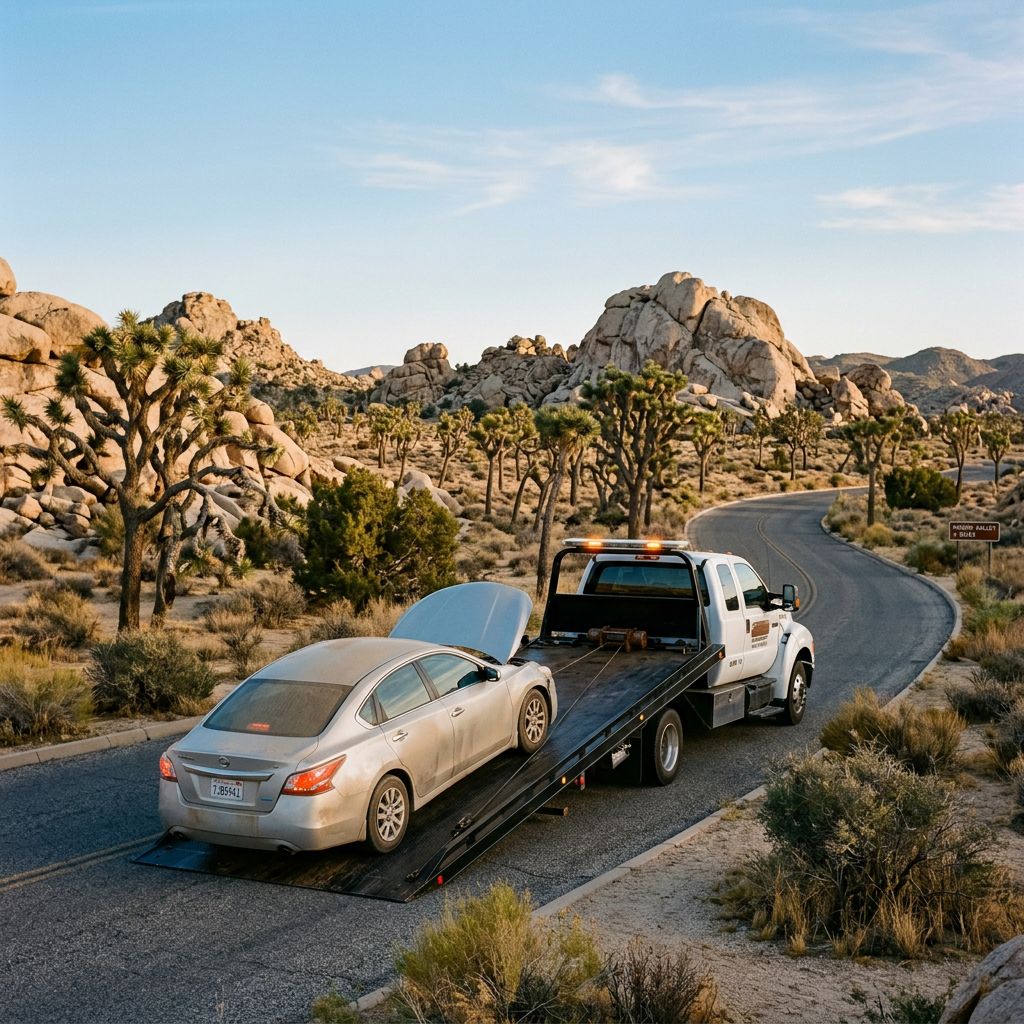
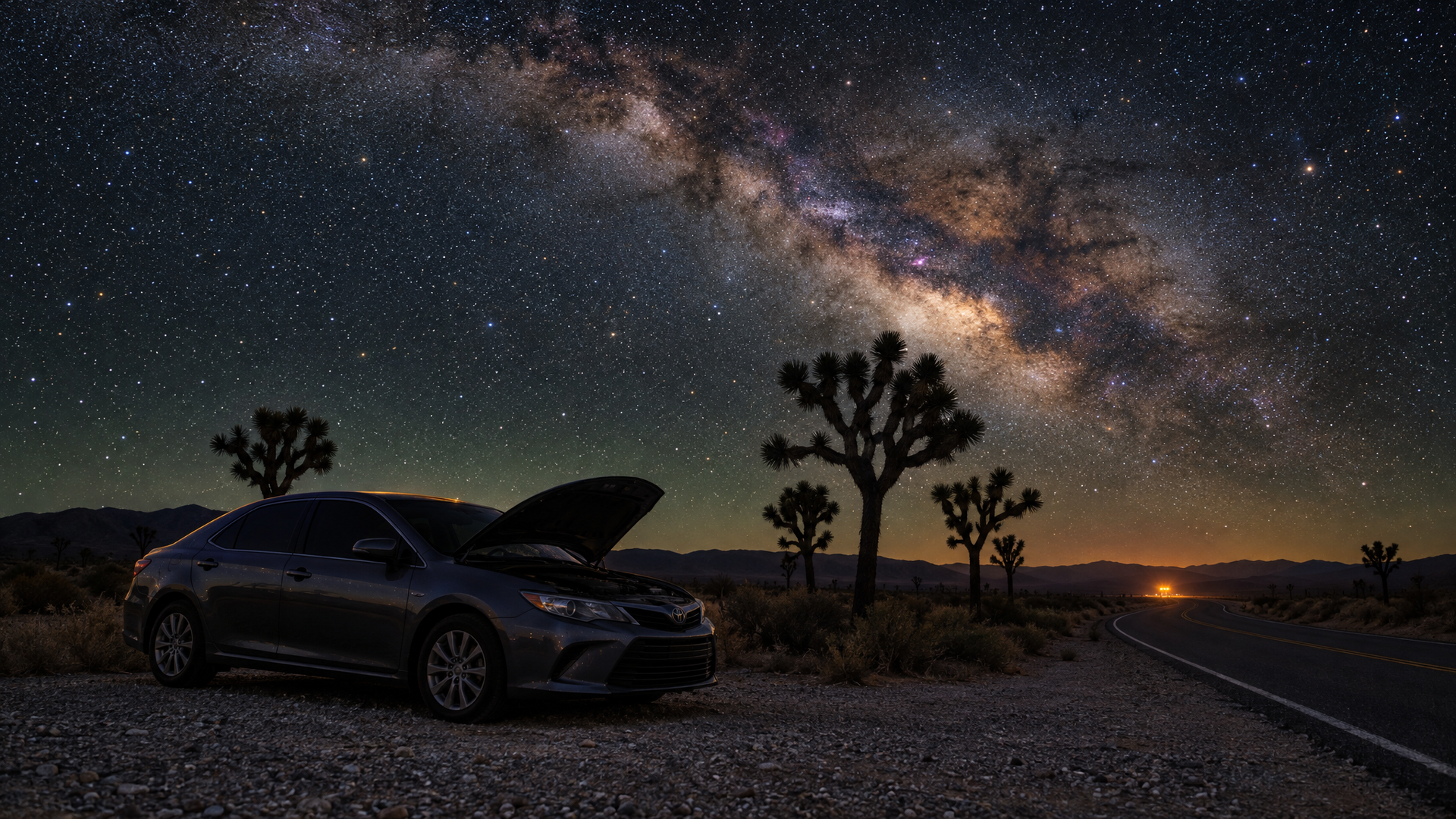
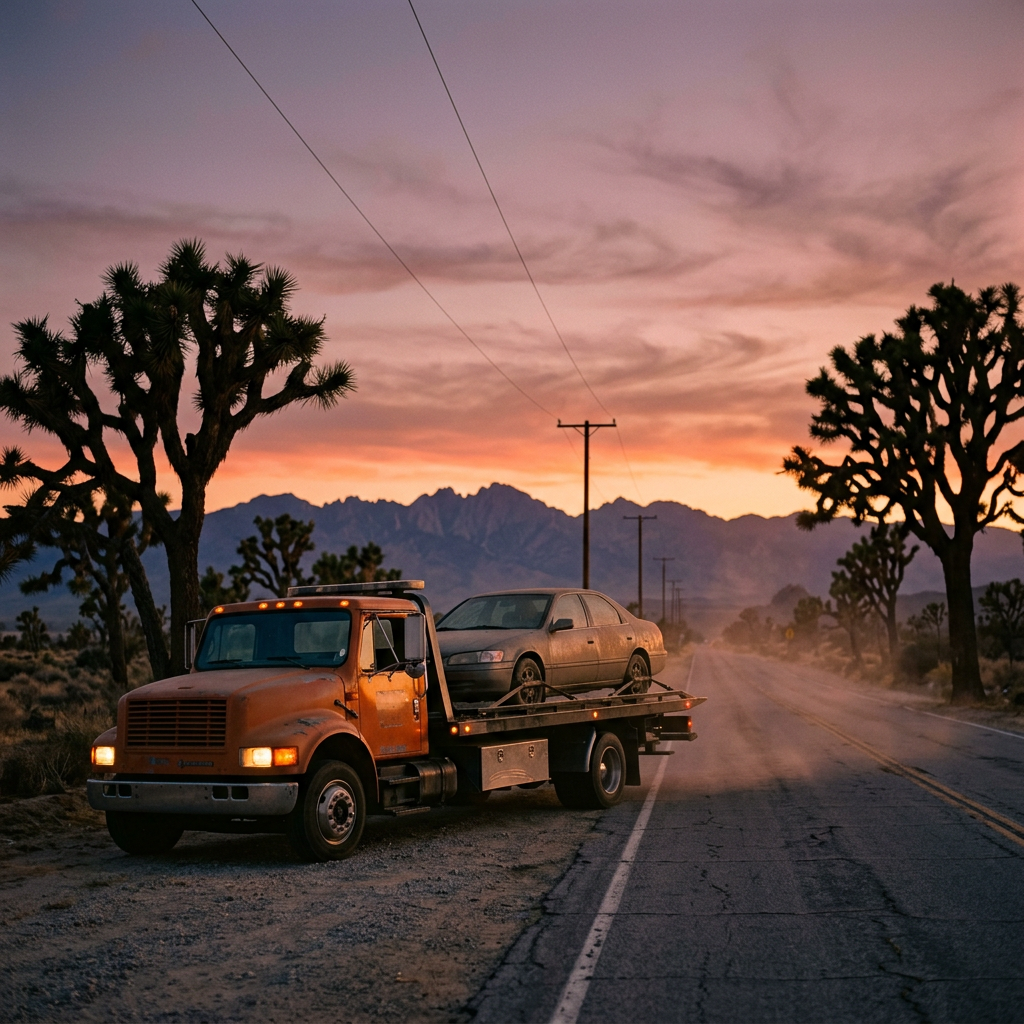
You drove into Joshua Tree National Park this morning to see the boulders, the Joshua trees, and maybe Skull Rock at sunset. Your dashboard just lit up with a check engine light. Or your temperature gauge is climbing. Or you took a wrong turn onto an unpaved road and you're stuck in sand. Or your battery died at a viewpoint and the car won't start.
You pull out your phone. No signal.
This is the moment that defines a Joshua Tree trip — either as the story you laugh about later or the one where you spend six hours in the desert sun waiting for a tow that doesn't know how to find you. The difference is almost entirely about what you do in the first 30 minutes.
Joshua Tree National Park sees more than 3 million visitors a year, and a meaningful percentage of those visitors will need a tow, a jump, a tire change, or some kind of recovery service inside the park boundary. Here's the practical guide to getting unstuck — written by people who actually run the recoveries.
First: Where Cell Service Actually Works in Joshua Tree
The single most important fact about breaking down in Joshua Tree National Park is that most of the park has no cell signal. Carrier coverage maps lie. Verizon, AT&T, and T-Mobile all show patchy or nonexistent service across the park interior, and the few "covered" zones are often unusable in practice.
Where you can usually get signal:
- Oasis Visitor Center (Twentynine Palms entrance) — reliable signal on most carriers. This is the most consistent signal point in the park.
- Park Boulevard near the Twentynine Palms entrance — first 1 to 2 miles inside the north entrance, signal usually works.
- Black Rock Campground (Yucca Valley side) — partial signal on the western edge of the park.
- Cottonwood Visitor Center (south entrance) — intermittent, sometimes works.
- Higher elevation viewpoints — Keys View, Ryan Mountain trailhead area can sometimes pull a signal because of line-of-sight to towers in the Coachella Valley.
Where you almost certainly will not get signal:
- Pinto Basin Road — the entire 30+ mile run from Cottonwood to Pinto Basin
- Geology Tour Road — unpaved, deep park interior, no service
- Covington Flats — remote western section
- Most of the park between Hidden Valley and Cottonwood — including Skull Rock, Cholla Cactus Garden, and the bulk of the area visitors actually photograph
- Any unpaved or backcountry road
If your phone has no signal, walking up onto a nearby rock formation does occasionally help. Driving slowly toward a known signal point is usually the better answer if the vehicle is still operable.
What to Do If Your Vehicle Is Still Drivable
If the car is running but something is wrong — temperature warning, oil pressure light, weird noise, low tire pressure — don't gamble. The temptation to "just make it back to the highway" has stranded a lot of cars in worse spots.
The right move:
- Pull off the road safely at the next wide shoulder, pullout, or trailhead parking lot. Don't stop in a curve, on a blind hill, or anywhere you can't be seen by oncoming vehicles.
- Turn on your hazard lights and engage the parking brake.
- Note your exact location. Park Boulevard mile marker, the trailhead name, the campground number — anything specific. "Somewhere near a big rock" doesn't help anyone find you.
- If you have signal, call for a tow immediately. Do not wait to "see if it gets better." It won't.
- If you don't have signal, drive slowly toward the nearest known signal point — usually back toward whichever entrance you came in. Drive at 25-35 mph, monitor your warning indicators, and stop immediately if anything escalates.
Driving 5 miles on a temperature-warning vehicle is sometimes the right call. Driving 20 miles into deeper park interior because you're stubborn about your itinerary is how engines crack heads.
What to Do If Your Vehicle Is Stuck or Won't Start
This is the harder scenario. Battery dead, transmission failed, stuck in sand, flat tire with no spare, locked keys in the car. The vehicle isn't going anywhere on its own.
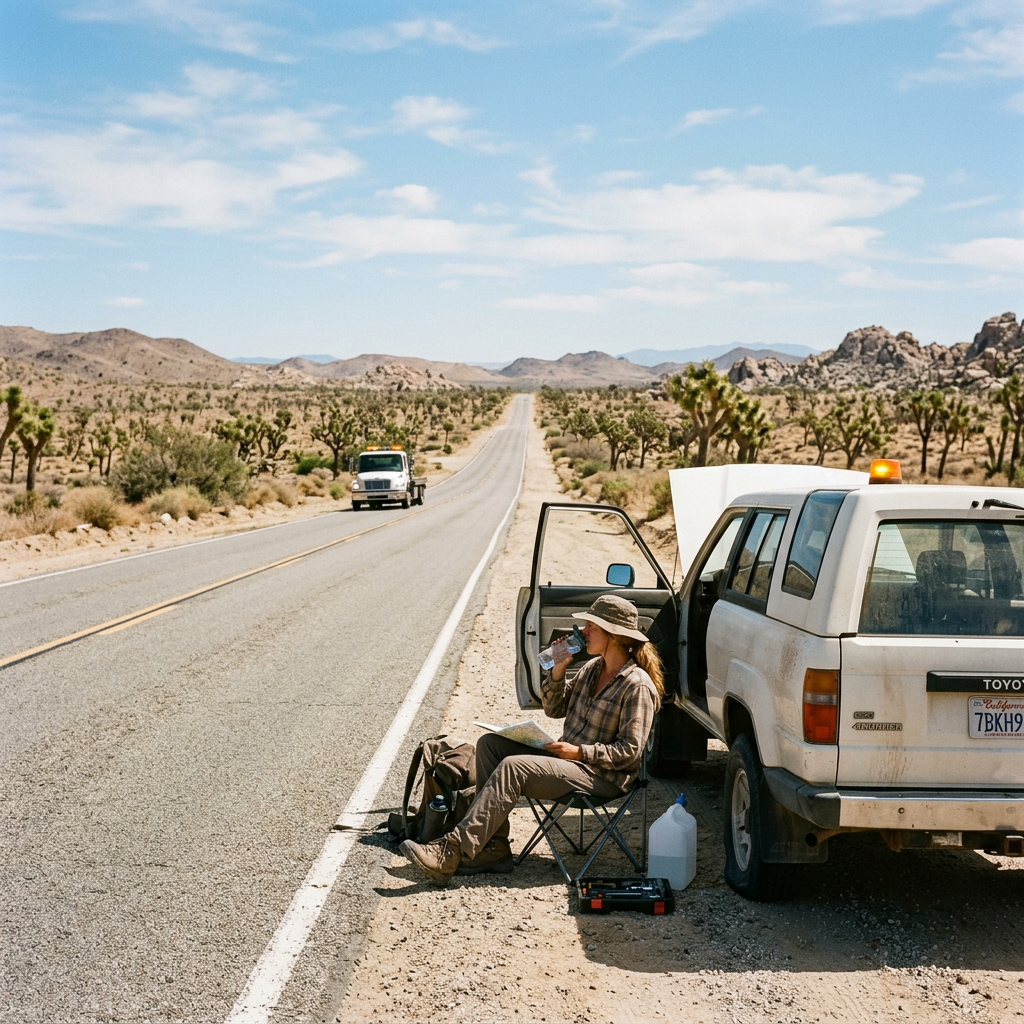
Stay with the vehicle. This is rule one. National Park Service search-and-rescue statistics consistently show that the most dangerous thing visitors do when their vehicle becomes disabled is try to walk for help. Joshua Tree summer temperatures regularly hit 105 to 115°F. Heat exhaustion and heatstroke can develop in under an hour of sun exposure with limited water. The vehicle is the single best shelter, water cache, and visible landmark you have.
Get into shade. If you're in the vehicle, crack windows and use sunshades on the dashboard if you have them. If the engine is dead and interior temperatures are climbing, sit in the shade of the vehicle on the side opposite the sun.
Conserve water. Whatever you have is what you have until help arrives. Don't drink it all in the first hour because you're nervous. Drink small amounts steadily.
Conserve phone battery. Reduce screen brightness to minimum, close all apps, and turn off Bluetooth and Wi-Fi. Do not stream music or scroll social media — your phone may be the only way to call out.
Make yourself visible. Hood up. Hazard lights flashing if the battery has any reserve. A bright shirt or towel hung on a side mirror or antenna helps drivers and rangers spot you from a distance.
If you have signal, call 911 first if it's a medical emergency or you have any injury. Otherwise call a local tow service directly. Do not call AAA's national 1-800 number from inside Joshua Tree if you can avoid it — AAA dispatches to whoever is on contract, which often means a 90-minute response from a Coachella Valley contractor. Calling a local Twentynine Palms tow company directly typically gets you a 30 to 45-minute response from a truck that's actually in the Morongo Basin.
If you have no signal, flag down a passing vehicle. Most park visitors will stop. Have them call a tow service for you when they reach a signal point — Oasis Visitor Center is the closest reliable signal from anywhere on Park Boulevard.
If no vehicles are passing, NPS rangers patrol the main roads regularly during daytime hours. They will eventually find you. Stay with the vehicle.
Telling a Tow Truck How to Find You Inside the Park
Joshua Tree's road system is unintuitive to dispatchers who don't work the park regularly. Here's how to give location information that actually works:
Use named landmarks first, mile markers second. "I'm at the Skull Rock pullout, on Park Boulevard, between the Jumbo Rocks Campground and Live Oak Picnic Area" is better than "I'm at mile marker 14." Both are useful. Both are better than "I'm in Joshua Tree."
Name the entrance you came in through. North entrance at Twentynine Palms, west entrance at Joshua Tree town, or south entrance at Cottonwood. This dramatically affects route and ETA.
Specify the road type. Park Boulevard is paved and tow-truck accessible. Pinto Basin Road is paved. Geology Tour Road, Berdoo Canyon Road, Old Dale Road, and Covington Flats Road are mostly unpaved and require specific equipment for safe recovery. The truck the dispatcher sends depends on the road.
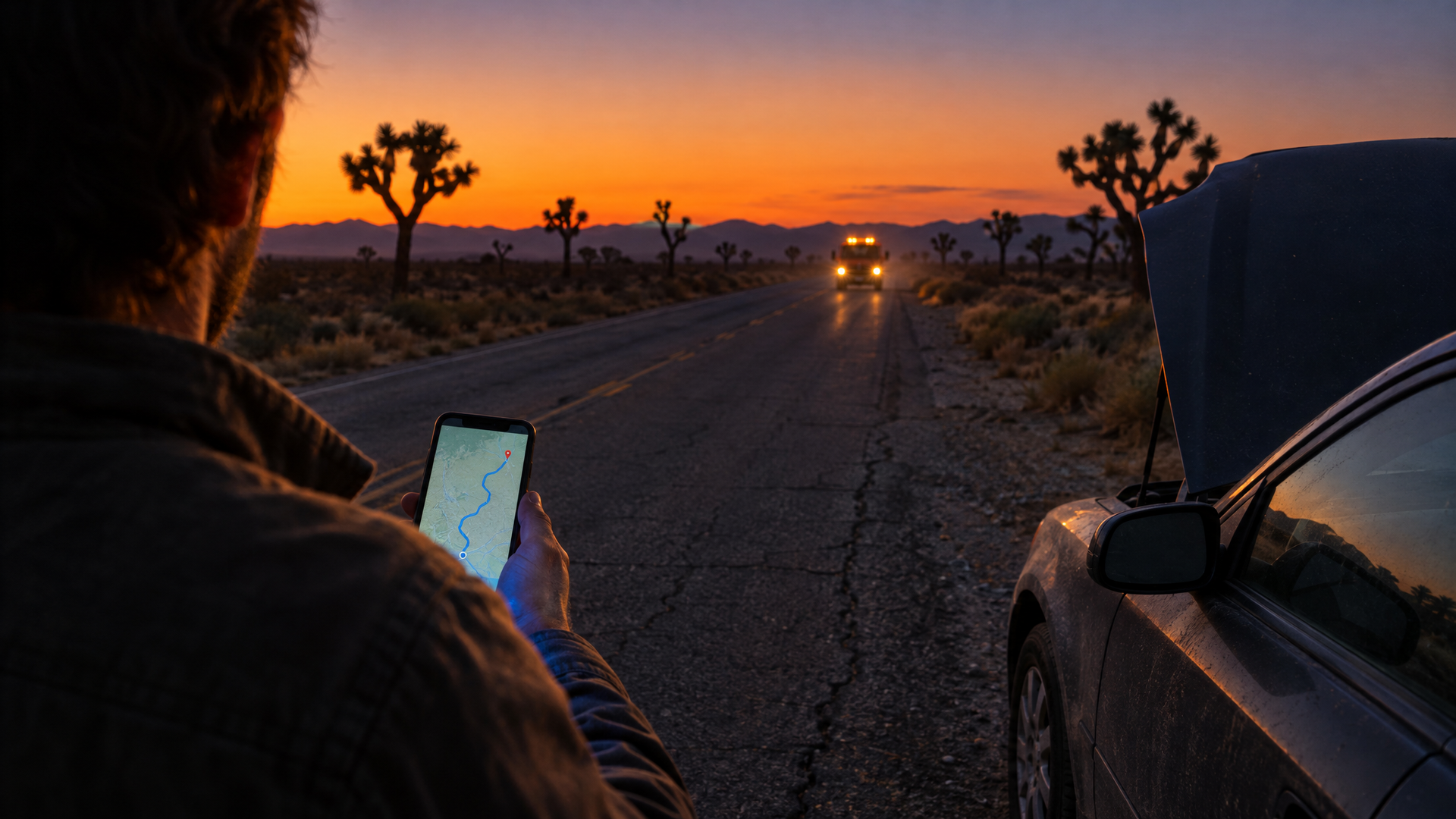
Share GPS coordinates if you can. If you have any signal at all, send the dispatcher a pin from Google Maps or Apple Maps. Coordinates beat verbal descriptions every time.
Stay on Park Boulevard or Pinto Basin Road if at all possible. Standard tow trucks can reach you anywhere on these roads. Off-road and unpaved routes require specialized recovery equipment, longer response times, and sometimes Park Service coordination.
What Recovery Looks Like Inside the Park
Once a tow truck is en route, here's what to expect:
Response time from Twentynine Palms to deep park interior runs 30 to 90 minutes depending on where you are. The Oasis area is 15 minutes. Skull Rock and Hidden Valley are 30 to 45 minutes. Cholla Cactus Garden and southern Pinto Basin Road are 60 to 90 minutes.
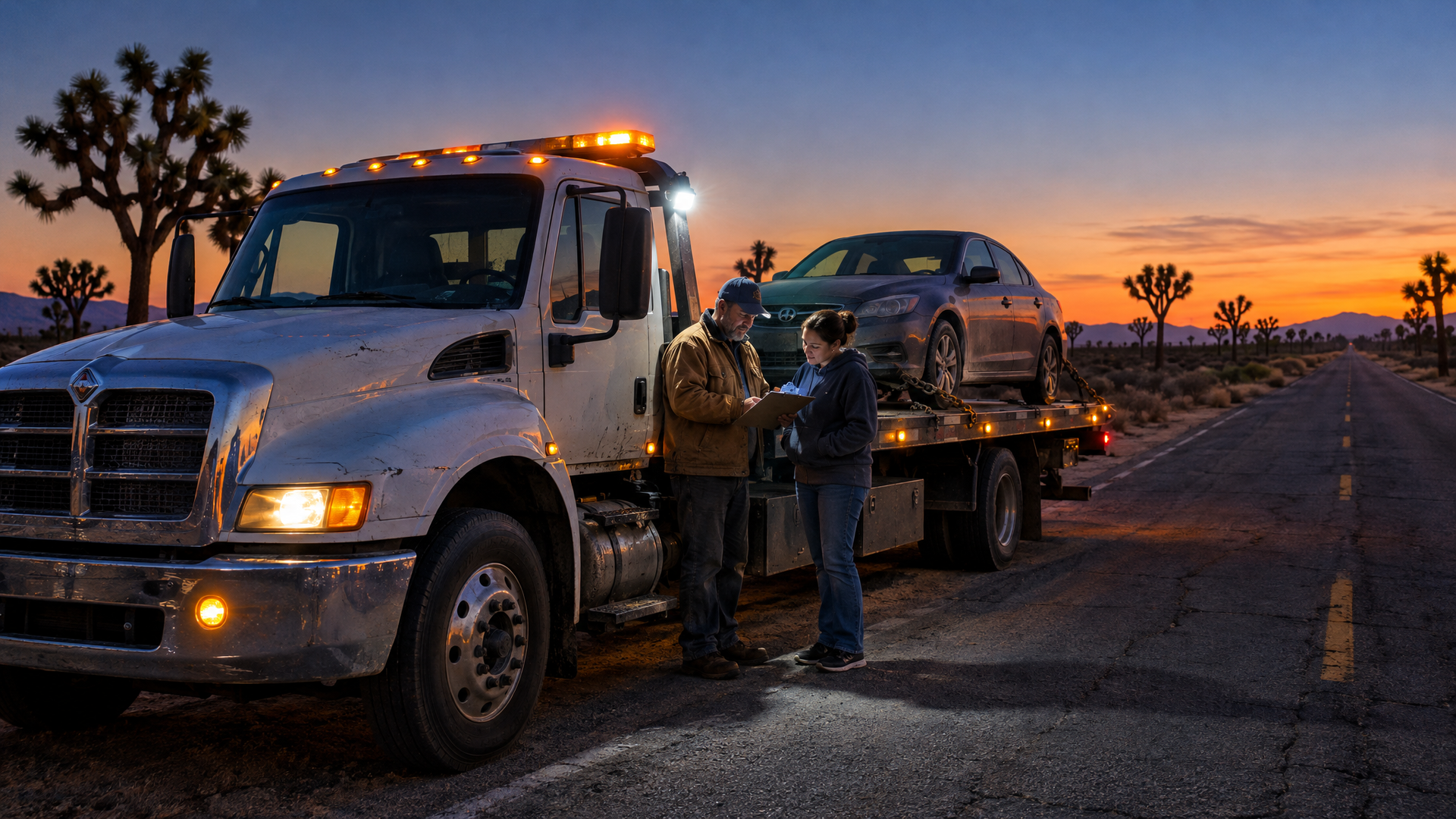
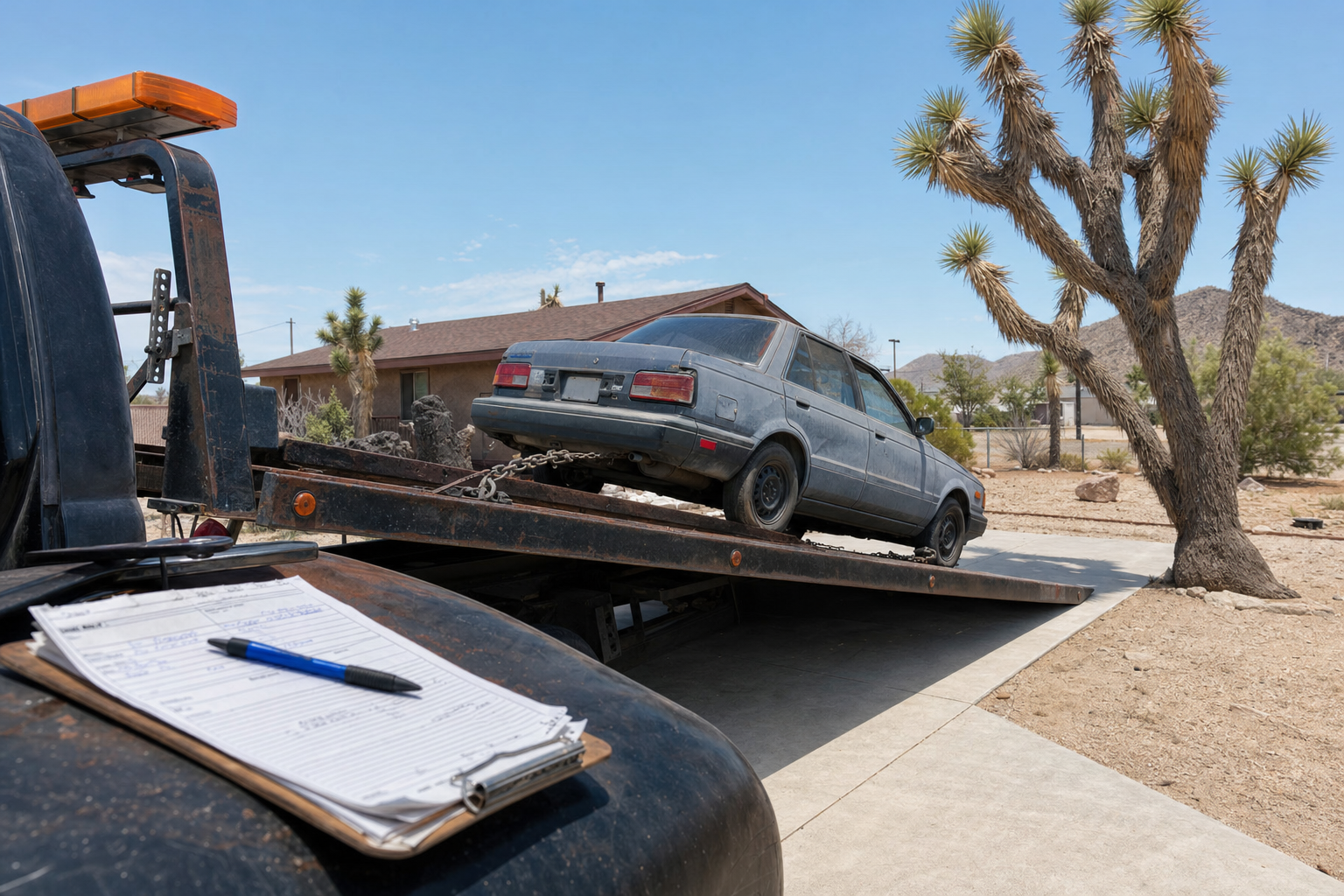
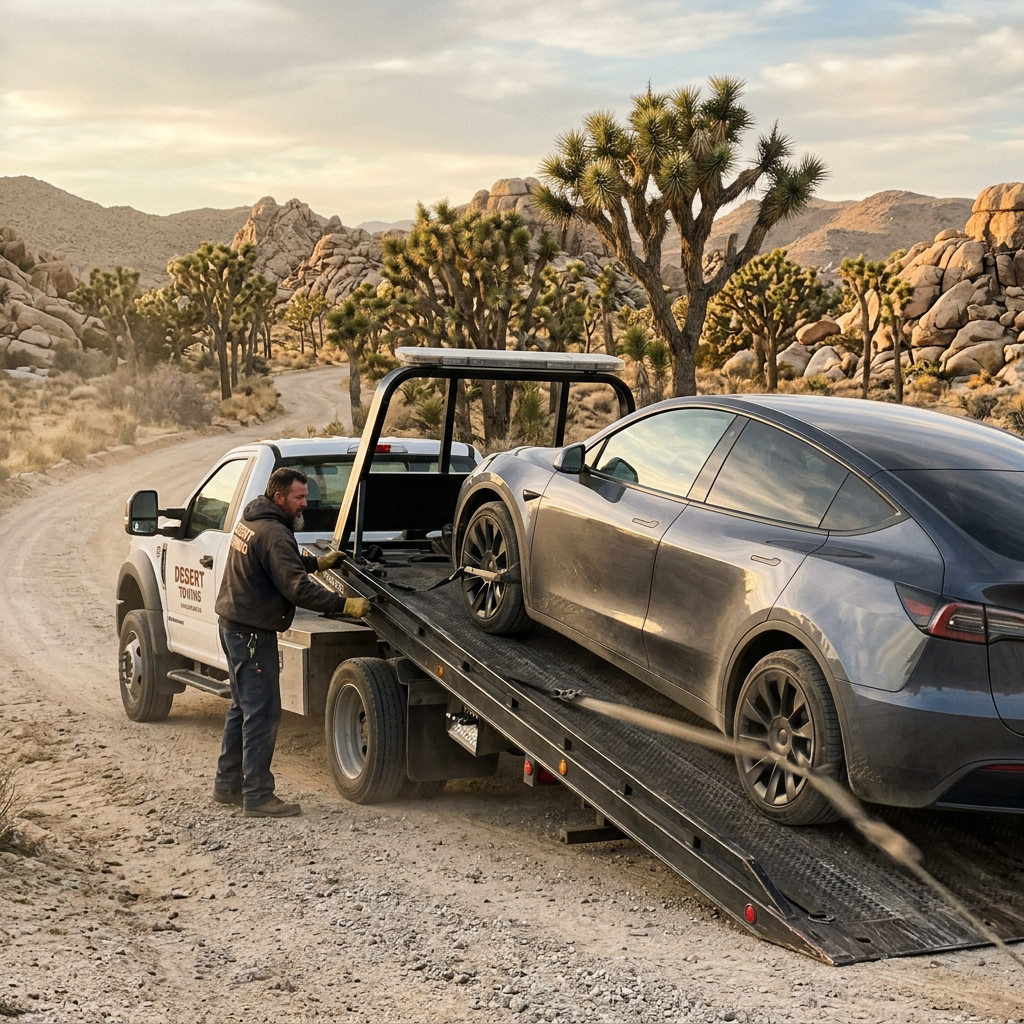
Flatbed is almost always the right truck. Wheel-lift tows are faster but harder on modern AWD and unibody vehicles, and the long routes from inside the park to Twentynine Palms, Yucca Valley, or Palm Springs make flatbed safer for the vehicle.
Park entrance fees and access. Tow trucks responding into the park enter through whichever gate is closest. Park rangers and entrance staff are familiar with the local towing companies and routinely allow access without delay. If you're inside the park, you don't need to do anything to "let the tow truck in" — your call to the company is enough.
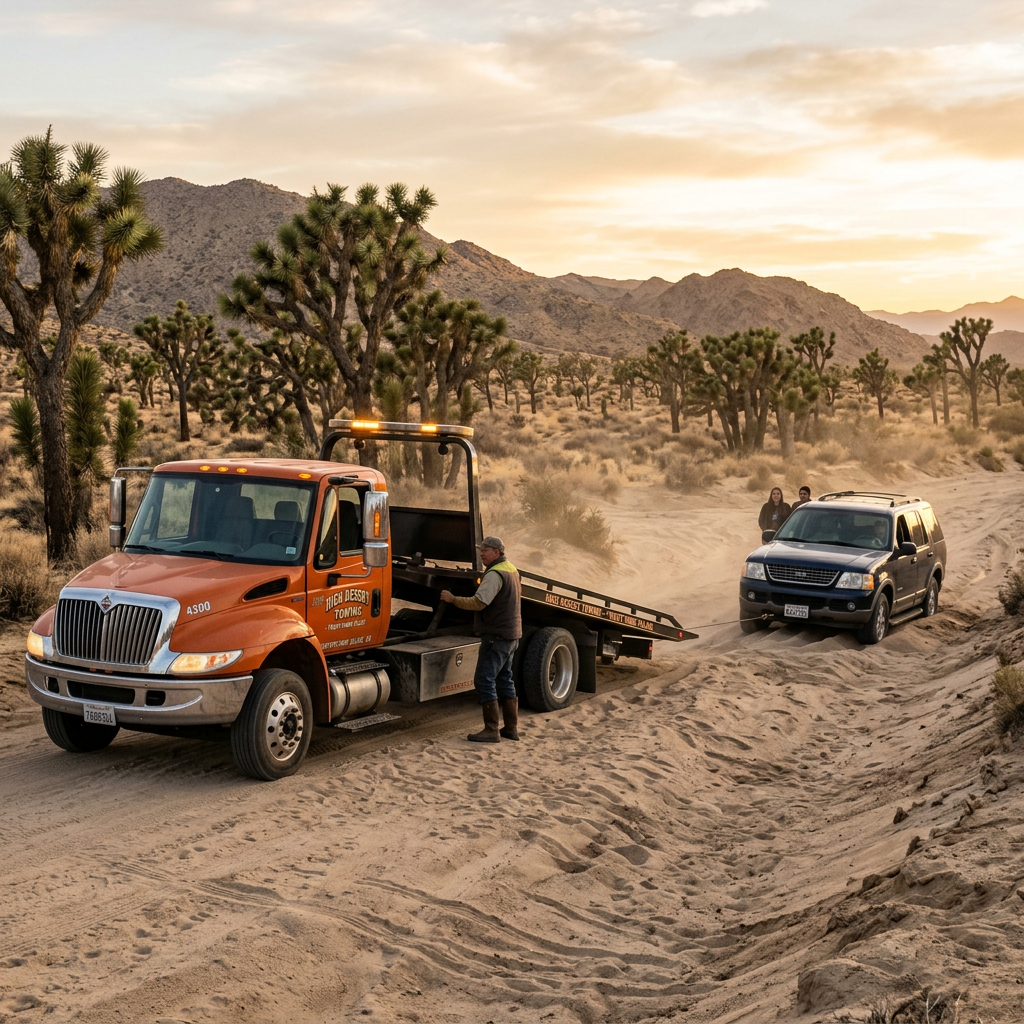
Off-road recovery requires specific equipment. If you're stuck in sand on an unpaved road, the truck dispatched needs to have appropriate winching equipment, recovery boards, and experience with desert vehicle extraction. Improperly executed sand recovery can damage the vehicle's drivetrain, frame, or suspension. This is one of the reasons it matters that the company you call actually works in this terrain regularly.
Where the vehicle goes. Most park breakdowns end up at one of three destinations: a repair shop in Twentynine Palms, Yucca Valley, or Joshua Tree if the issue is fixable locally; the visitor's accommodation if the vehicle just needs to be moved off the road; or a long-distance flatbed transport to Palm Springs or San Bernardino if the car needs a dealer or specialty service. Discuss this with the tow operator on arrival — the right destination depends on what's wrong with the vehicle.
The Most Common Joshua Tree Breakdowns We See
Pattern recognition from running these recoveries year-round:
Overheating in summer. Older vehicles and rental cars climbing the grade out of the Coachella Valley toward Cottonwood, or running AC in stop-and-go traffic at Hidden Valley parking on busy weekends. The fix on scene is usually impossible — flatbed transport to a repair shop is the right call. Don't keep driving an overheated vehicle "just a few more miles."
Dead batteries at viewpoints. Visitors leaving headlights on, accessory power running, or simply old batteries failing in the heat. Roadside jump start is usually all that's needed, and the vehicle drives out under its own power. Call from Keys View, Ryan Mountain trailhead, or any signal point — the response is fast.
Flat tires from rough roads. Geology Tour Road, Berdoo Canyon, and the unpaved sections of the park are hard on passenger-car tires. Many drivers don't have a usable spare or a working jack, especially in rental cars. Roadside tire change or limp the car back to a paved road on a donut where possible.
Stuck in sand off the pavement. Drivers pull over to take a photo, end up off the gravel shoulder, and discover that two-wheel drive doesn't get out of soft sand without help. Winch recovery is the answer. Do not try to dig out with hands and floor mats — you'll either bury the car deeper or damage the underbody.
Locked keys in the car. Common at trailhead parking. Lockout service typically gets the door open in 5 to 10 minutes. The wait time is the response time, not the work time.
Lost or no fuel. Fuel exhaustion is more common than people think — especially on visits that include the southern entrance, where the gap between gas stations is genuine. Fuel delivery is faster than a tow.
Transmission, drivetrain, or major mechanical failures. These need flatbed and a destination decision. If the vehicle is under warranty, a dealer in Palm Springs or San Bernardino is usually the right destination, even if the longer transport costs more.
Cell Service and Communication Strategy Before You Enter the Park
Most park breakdown emergencies become serious because of communication, not because of the breakdown itself. The fix is preparation.
Save a Twentynine Palms tow company number in your phone before you enter the park. Including ours: (442) 205-6198. Save it under a name that's findable — "29 Palms Tow" or "Joshua Tree Tow" — so a stranger can find it on your phone if you can't.
Tell someone your itinerary. A spouse, a friend, a hotel front desk. "We're entering through Twentynine Palms at 10am, planning to do Skull Rock, Hidden Valley, and exit through Joshua Tree town by 5pm." If you don't check in by some reasonable time, they have a starting point.
Top off fuel and water before entering. Twentynine Palms, Yucca Valley, and Joshua Tree town all have gas stations. The park does not. Carry at least one gallon of water per person regardless of how short you think your visit will be.
Carry a paper map. NPS provides them at every entrance. When the phone dies or has no signal, the paper map is what you use to describe your location.
Know your escape routes. From Park Boulevard, the closest entrances back to civilization are Twentynine Palms (north) and Joshua Tree town (west). From Pinto Basin Road, Cottonwood is south. Knowing which way is shortest from where you are is useful information when you're trying to drive a marginal vehicle out.
Carry basic recovery gear if you're going off Park Boulevard. Even a small shovel, a tire pressure gauge, and a 12-volt air compressor (the kind that plugs into a cigarette lighter) cover most flat-tire and sand-stuck scenarios.
When NPS Search-and-Rescue Gets Involved
Most Joshua Tree vehicle breakdowns are commercial tow situations. Some become NPS search-and-rescue operations. The line is usually:
- Medical emergency — heat exhaustion, dehydration, cardiac event, injury → NPS or 911
- Vehicle stuck off the road system entirely — driven into terrain a recovery vehicle can't reach → NPS may coordinate
- Visitor missing or overdue — vehicle found unattended, no contact for hours → NPS search-and-rescue
- Standard breakdown on a road accessible to tow trucks → Commercial tow
If you're not sure which category you're in, call 911 first. Joshua Tree NPS dispatch can hand off to a commercial tow service if SAR isn't needed. The reverse — calling a tow company first when you actually need medical attention — wastes time you may not have.
Frequently Asked Questions
How much does it cost to get a tow from inside Joshua Tree National Park? Pricing depends on where you are, where the vehicle is going, and whether the recovery requires winching or special equipment. A standard tow from a paved park road to Twentynine Palms typically runs $150 to $350. Long-distance tows to Palm Springs or San Bernardino run $400 to $900+. Off-road recovery from sand or unpaved routes adds a winching fee. Get the estimate on the phone before the truck rolls.
Will my insurance or AAA cover a Joshua Tree National Park tow? AAA covers tows nationally but routes through their dispatch network — response times are often slow from inside the park. Insurance roadside coverage similar story. Both will reimburse the cost of using a local tow company in many cases — pay the local company directly, get the receipt, submit it to your provider for reimbursement. You'll get help faster.
What if I break down at night in Joshua Tree? Park is open 24/7, towing companies are available 24/7. Night recoveries take longer because of visibility and traffic, and rangers patrol less frequently overnight. Stay with the vehicle, hazards on, conserve battery, call when you have signal. Most night breakdowns get resolved within 60 to 90 minutes once contact is made.
My rental car broke down in the park — does the rental company handle it? The rental company can dispatch a tow but they almost always use a national contracted service that response is slow from. Most experienced renters call a local Twentynine Palms tow service for the recovery, get the vehicle to a safe location, then deal with the rental company's swap-out logistics from there. Save the receipts — most rental contracts reimburse reasonable recovery costs.
Can a tow truck access unpaved roads in Joshua Tree? Some can, some can't. Standard flatbed and wheel-lift trucks are limited to paved roads. Specialized desert recovery trucks with high clearance, four-wheel drive, and proper winching equipment can handle unpaved routes like Geology Tour Road, Berdoo Canyon, and Old Dale Road. When you call, mention the road surface — that determines the truck dispatched.
What's the maximum distance a tow can run from Joshua Tree? Local tows to Twentynine Palms, Yucca Valley, Joshua Tree, and 29 Palms area shops are routine. Long-distance flatbed transport to Palm Springs (about 60 miles), San Bernardino (about 70 miles), Riverside (about 90 miles), or all the way to Los Angeles is available with advance notice. Long-distance is priced by the mile beyond the local service area.
My car needs a specific dealer — can you tow it directly there? Yes. Most major manufacturer dealers are in Palm Springs, San Bernardino, or Riverside. Direct flatbed transport to a specific dealership is common for warranty issues and specialty vehicles (Tesla, BMW, Mercedes, Land Rover, Jeep, etc.).
What if my car is at a campsite? Park campgrounds are accessible to tow trucks. Common scenario: car won't start in the morning at Jumbo Rocks or Indian Cove. Tow truck enters through the closest park gate, drives to the campsite, jump-starts or tows out. No special arrangement needed.
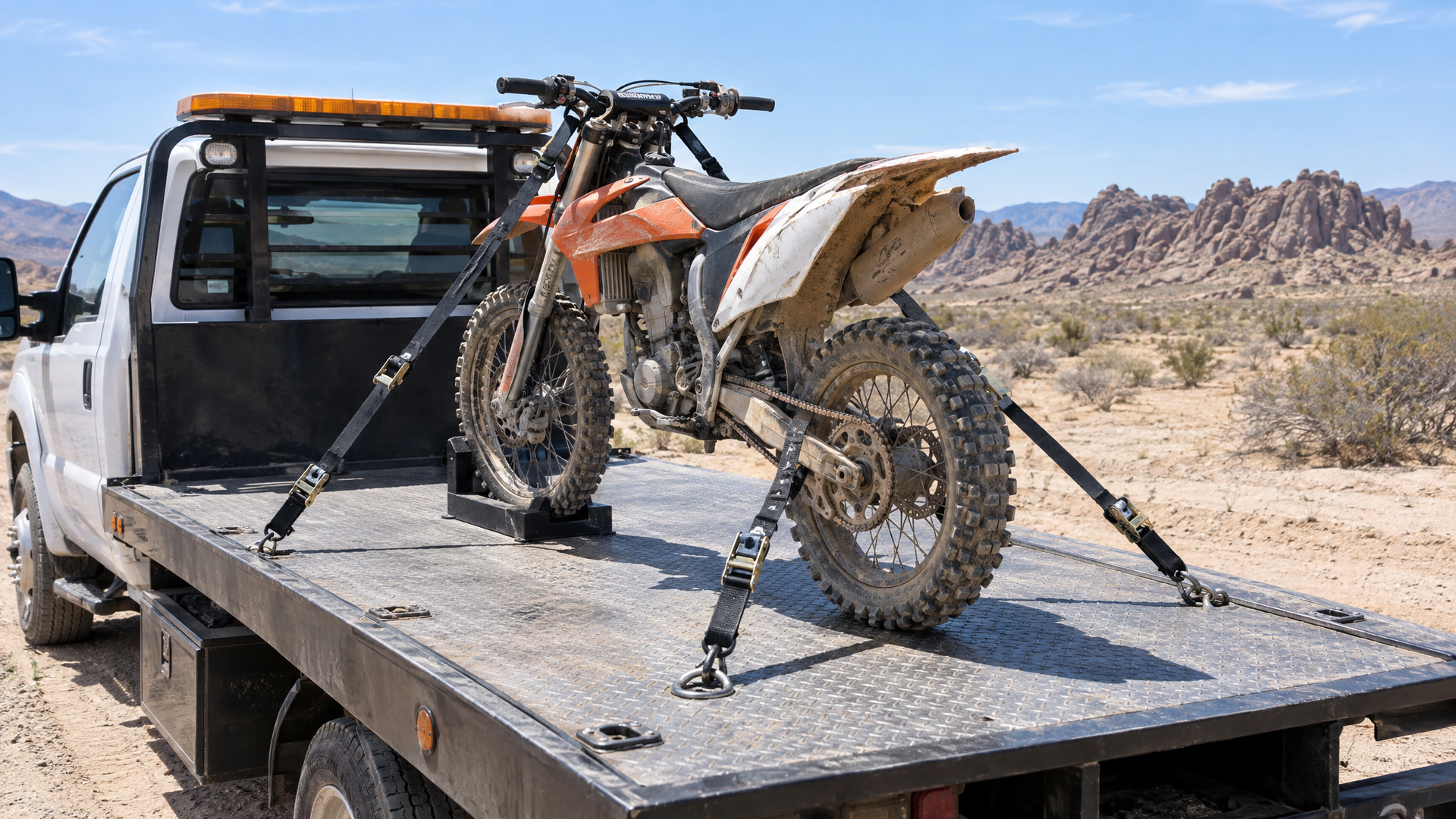
Do you tow motorcycles in Joshua Tree? Yes. Joshua Tree is heavy adventure-bike and dual-sport country. Motorcycle towing requires either a flatbed with appropriate tie-downs or a motorcycle-specific carrier. Mention it's a motorcycle when you call so the right truck arrives.
What about RVs and large vehicles? Heavy-duty towing for RVs, trucks with trailers, and large vehicles is available but limited to paved park roads and requires specific equipment. Some RV recoveries take 2 to 4 hours just to reach the vehicle. Larger vehicles often involve coordinating tire repair on-site rather than full towing — it's a different operational scope.
How can I avoid breaking down in Joshua Tree in the first place? Top off fuel before entering. Check tire pressure (heat affects it dramatically). Don't run AC at idle for long periods on older vehicles. Stay on paved or well-traveled gravel roads unless you have a high-clearance vehicle and recovery gear. Don't drive into sand "just to see what's down there." Carry water, a paper map, and a saved local tow number.
Save This Number Before You Visit Joshua Tree
If you're heading into Joshua Tree National Park — whether it's your first visit or your fiftieth — save (442) 205-6198 in your phone right now. Twentynine Palms Towing is locally based at 73421 29 Palms Hwy in Twentynine Palms, with trucks dispatched from the Morongo Basin, not the Coachella Valley. We respond 24 hours a day, 7 days a week, and we work the park interior regularly enough to know which roads which trucks can access.
We handle emergency towing, roadside assistance, jump starts, lockouts, flat tires, off-road and sand recovery, motorcycle towing, and long-distance flatbed transport to Palm Springs, San Bernardino, and beyond. Licensed, insured, and dispatched from Twentynine Palms — not from a national call center an hour away.
Save the number before you need it. The park doesn't have cell service, and the desert doesn't wait.