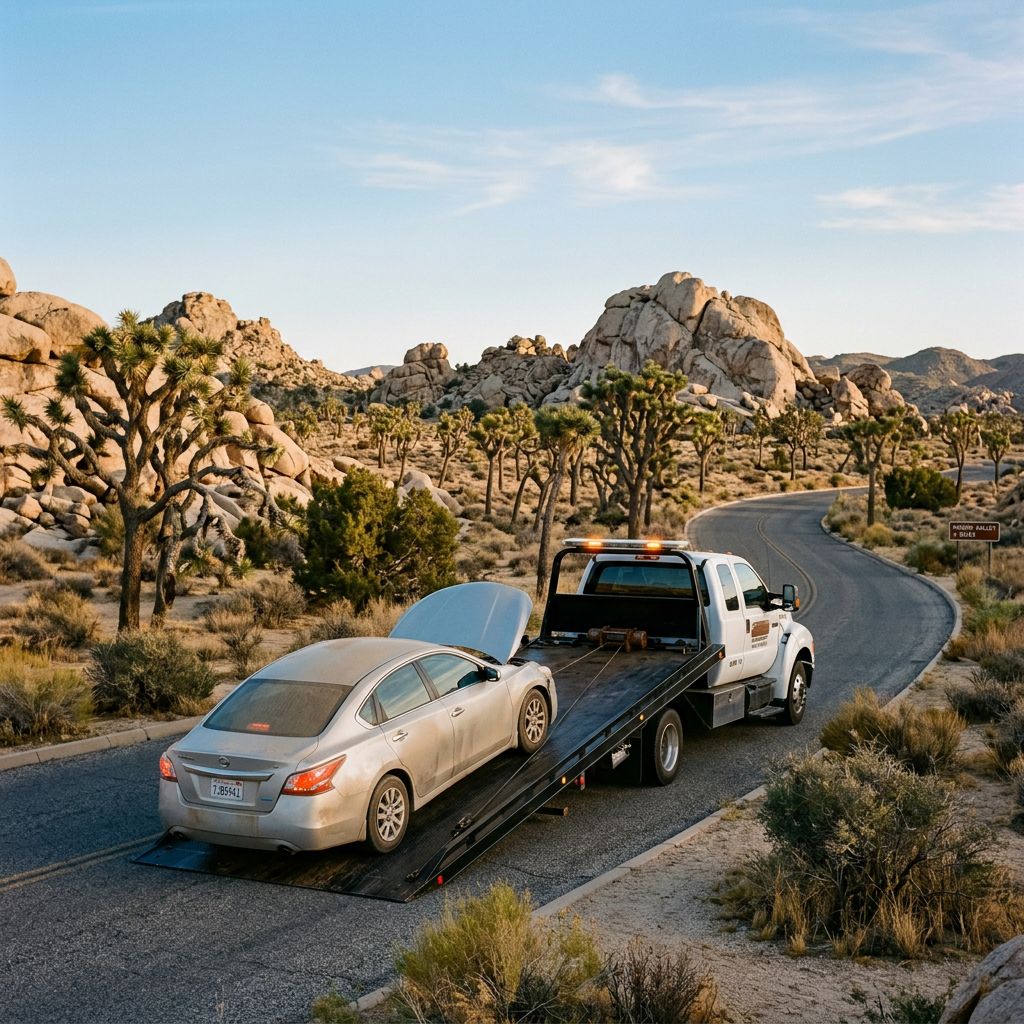
Stuck in the Sand Near Joshua Tree? What Off-Road Winch-Out Recovery Actually Looks Like in Twentynine Palms
Stuck in the Sand Near Joshua Tree? What Off-Road Winch-Out Recovery Actually Looks Like in Twentynine Palms
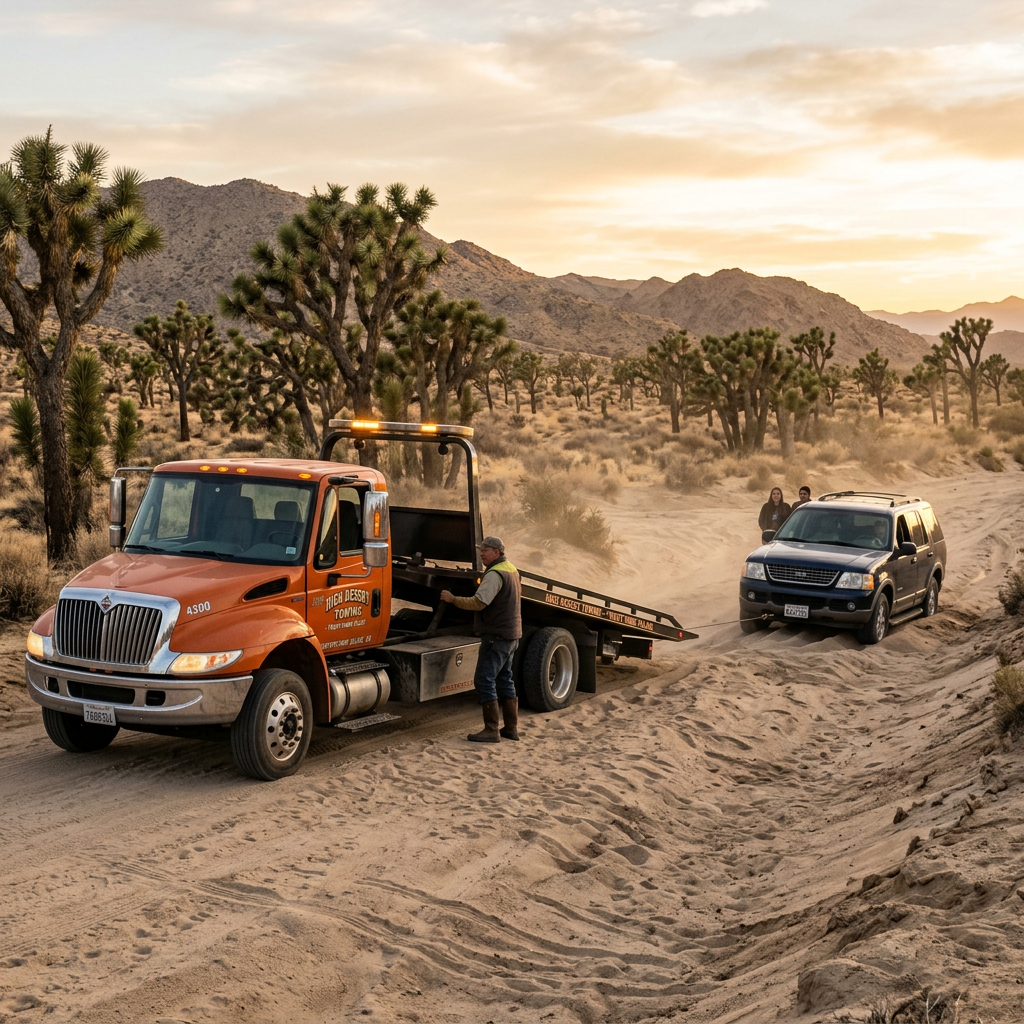
You took the turn off Pinto Basin Road thinking the wash looked firm. Or you pulled off Old Dale Road to grab a photo of the Pinto Mountains and felt the front tires sink. Maybe you were on the Geology Tour Road in a stock SUV, hit a patch of soft sand near Squaw Tank, and now you're high-centered with the diffs resting on the desert floor. Whatever the route in, the problem is the same: a 4,000-pound vehicle is buried up to the rocker panels somewhere between Twentynine Palms and Wonder Valley, the sun is climbing, and the AAA app says "service unavailable in this area."
This is the part of desert towing nobody talks about until it happens to them. Standard roadside towing in Twentynine Palms — the kind you call for a flat tire on Highway 62 outside Stater Bros. — and sand recovery in the open Morongo Basin are not the same job. The truck is different, the technique is different, and the consequences of doing it wrong are the difference between a $400 winch-out and a $6,000 frame straightener. Here's what off-road winch-out recovery actually involves in the Twentynine Palms area, when you need it, and how to keep a bad situation from getting worse before help arrives.
Why Off-Road Recovery Is Its Own Specialty in the High Desert
The terrain between Twentynine Palms, Joshua Tree National Park, the Sheep Hole Mountains, and the Bullion Mountains is some of the most stuck-prone country in California. The Morongo Basin sits on a mix of decomposed granite, alluvial sand from the Pinto Mountains, and dry lakebed silt that turns into talcum powder when disturbed. Tourists driving rented Jeeps from Palm Springs underestimate Berdoo Canyon Road every weekend. Marines from MCAGCC explore the Bullions and find themselves wedged on a rock ledge in a borrowed truck. Locals who've driven Amboy Road a hundred times still slide off into the soft shoulder when the wind blows sand across the lanes near Sheep Hole Pass.
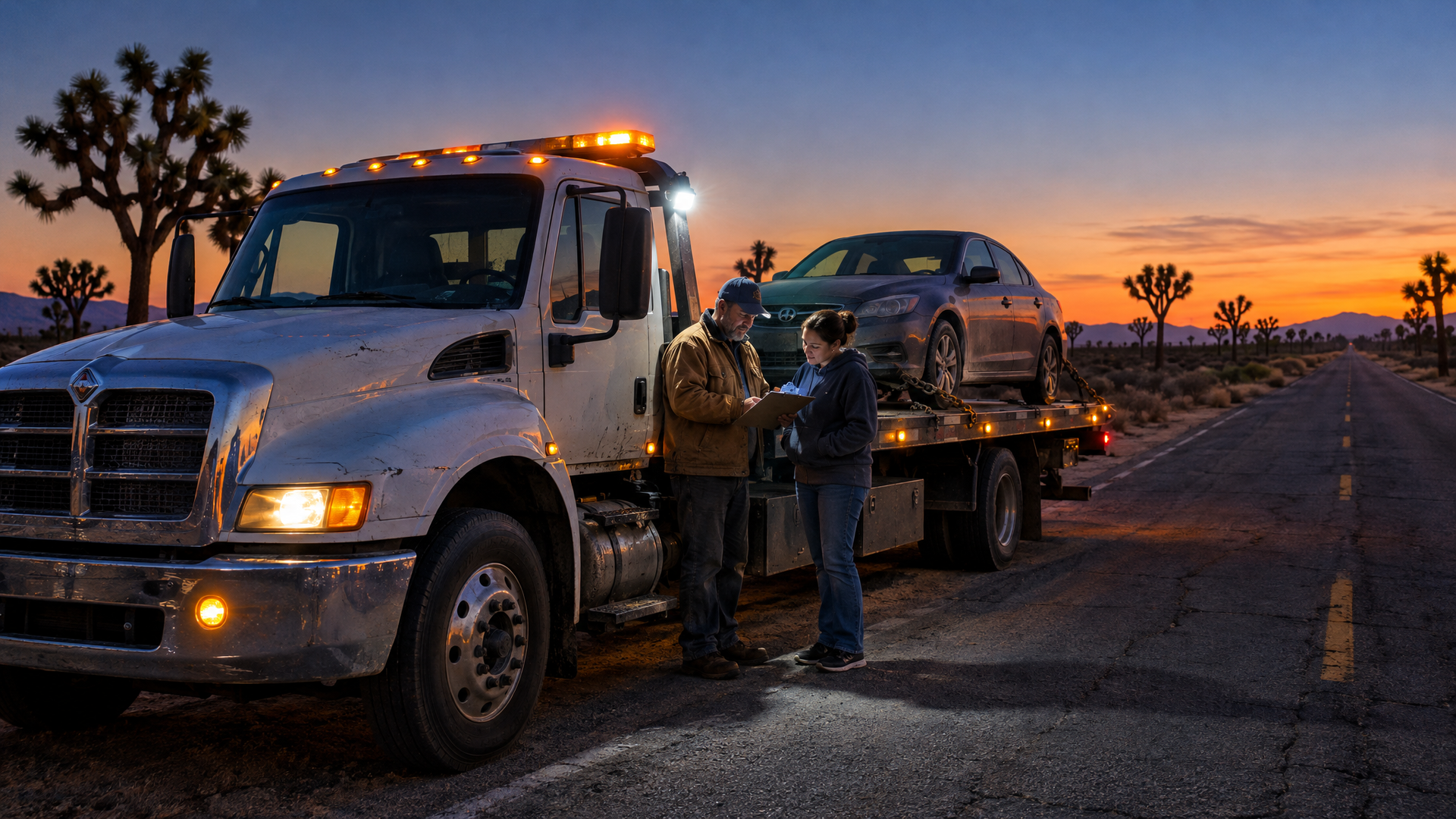
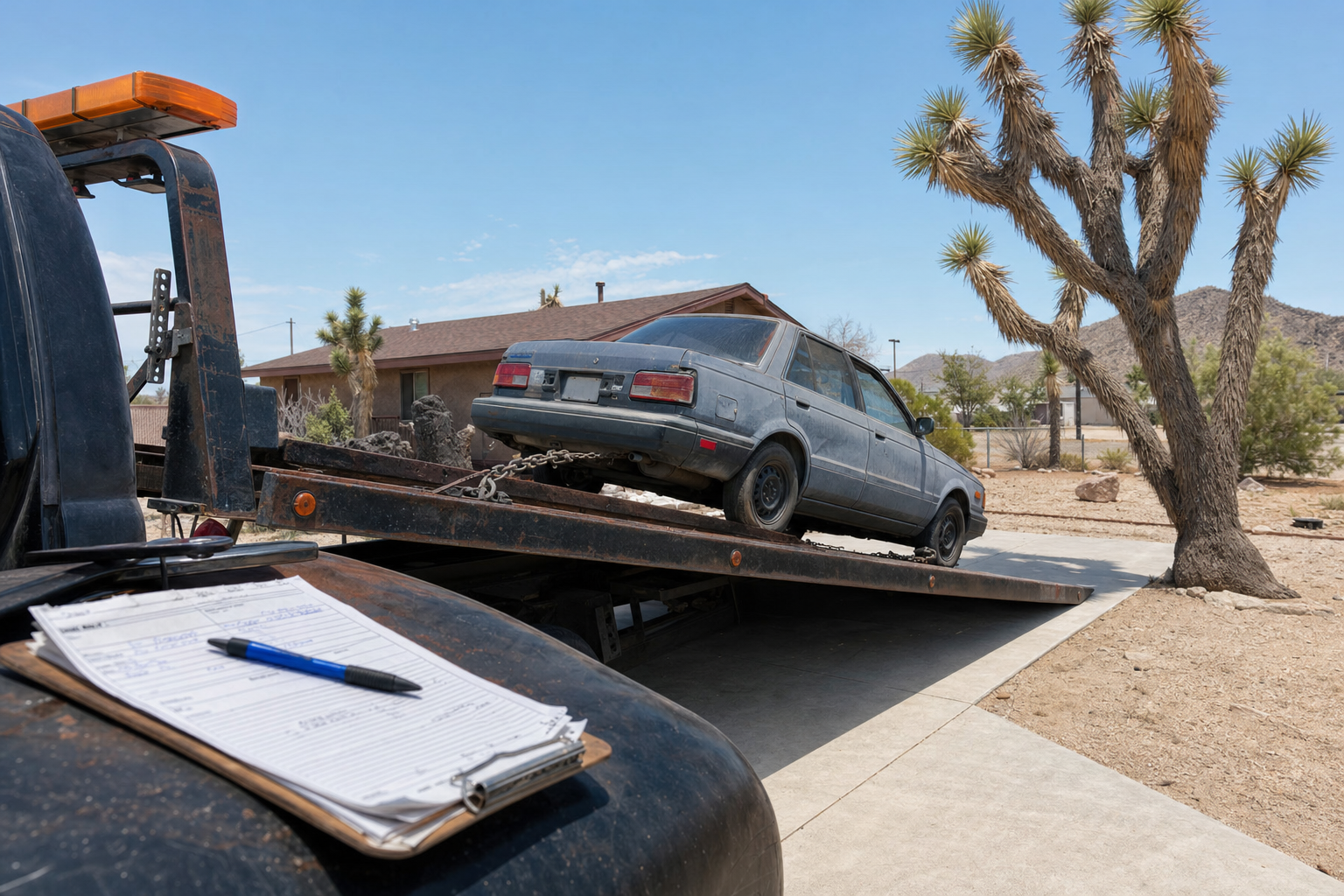
A standard wrecker — the kind that operates in Yucca Valley, Joshua Tree village, or the Twentynine Palms commercial corridor on Adobe Road — is built for paved-surface work. The truck is heavy, the boom is rated for asphalt deployment, and the operator's training is in collision recovery and disabled-vehicle removal. Send that same truck into a sand wash off Amboy Road and one of two things happens: either the wrecker itself gets stuck trying to reach the casualty, or the operator yanks the stuck vehicle out at the wrong angle and damages the frame, the bumper mounts, or the suspension geometry.
Real off-road recovery in the Twentynine Palms area requires three things a regular tow truck doesn't have. First, a flatbed or rotator with proper ground clearance and tire pressure flexibility to enter soft terrain. Second, a synthetic-line winch with at least 12,000-pound capacity, snatch blocks for angle pulls, and tree-saver or sand-anchor rigging for situations where there's nothing to anchor to. Third, an operator who can read desert terrain — knowing the difference between a sand wash that will swallow a 30,000-pound truck and a hardpack section that will support it, recognizing when a Hi-Lift jack and traction boards solve the problem faster than a winch line, and understanding how to recover a vehicle without dragging the oil pan across a rock ledge.
The Five Most Common Off-Road Recovery Calls in Twentynine Palms
Across the Morongo Basin, recovery calls cluster into five patterns. Understanding which one you're in tells you a lot about what to do before help arrives.
Sand bog in a dry wash. The most common call in the Twentynine Palms area. Most often happens off Old Dale Road, in the washes south of Wonder Valley near Highway 62, on the unpaved sections of Pinto Basin Road, or in the open desert north of the MCAGCC base boundary. The vehicle's weight breaks through the surface crust and the tires spin themselves into trenches. Stock SUVs on highway tires are the most frequent casualties — Honda Pilots, Toyota Highlanders, Ford Explorers driven by visitors from San Bernardino or Riverside County who took the wrong fork off a paved road.
High-centered on a rock or berm. Common on the Geology Tour Road inside Joshua Tree National Park, on Berdoo Canyon, and on the unmaintained tracks heading east toward Cleghorn Lakes Wilderness. The vehicle's chassis rests on an obstacle while the tires hang in the air with no traction. Once you're high-centered, throttle doesn't help — you need lift, recovery boards, or a winch pull combined with a jack to get the vehicle off the obstacle.
Off-camber slide. Happens on the sloped shoulders of Amboy Road, on the switchbacks of Berdoo Canyon, and on the steep sections of Covington Flats Road in the western part of Joshua Tree National Park. The vehicle slides downhill of the trail and ends up on its side or at an angle where the wheels can't gain purchase. These are the most dangerous recoveries because rolling risk is real.
Mud or wet-clay bog (rare but brutal). When the Morongo Basin gets one of its rare downpours — usually summer monsoons rolling up from Mexico or winter atmospheric rivers — the dry lake areas around Bristol Dry Lake near Amboy, the playas north of Twentynine Palms, and the low-lying sections of the Pinto Basin turn into clay traps. A vehicle sunk into wet playa clay can't be winched out the way a sand bog can — the suction is enormous, and pulling too hard rips the bumper off the frame.
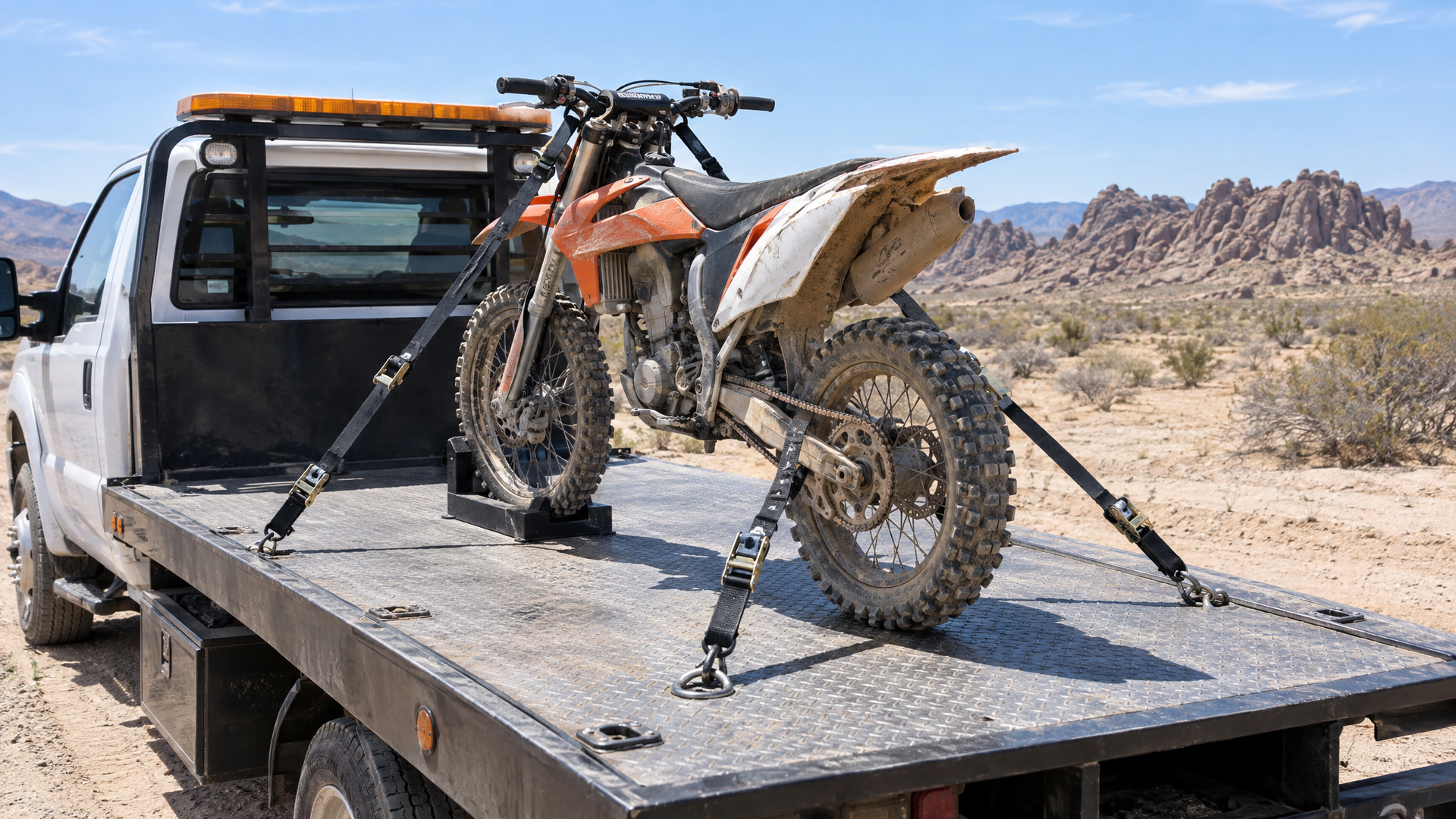
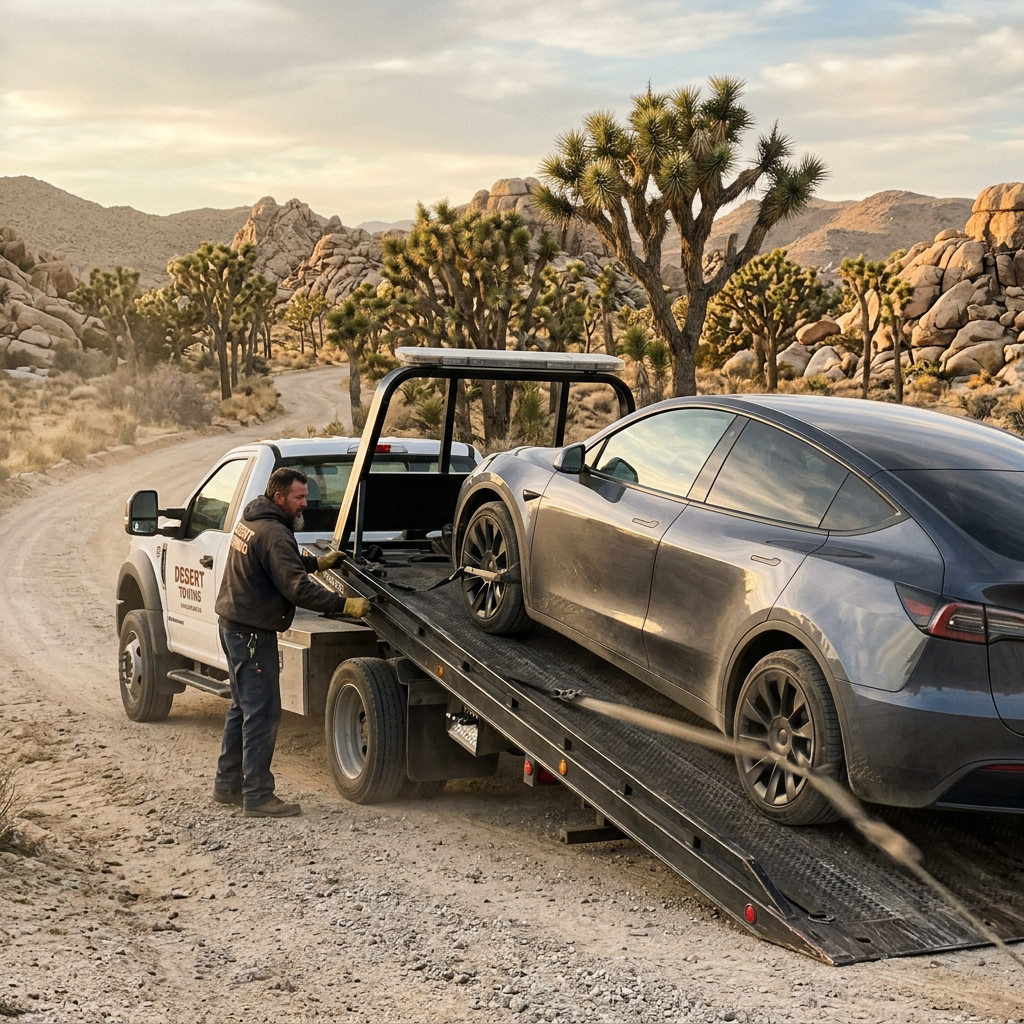
Off-pavement disabled vehicle. Not stuck, exactly, but broken down somewhere a regular tow truck can't safely reach. If you've broken down inside Joshua Tree National Park, the response steps are slightly different. Common scenarios: a Jeep that lost its drivetrain on Pinto Basin Road past the Cholla Cactus Garden, a sedan that overheated on the dirt portion of Box Canyon Road, a motorcycle down on the unpaved section heading toward the Cleghorn Lakes area. These calls need a flatbed that can enter the terrain and load the vehicle without dragging it across rocks.
What to Do Before the Tow Truck Arrives
The 30 to 60 minutes between your call and the arrival of a properly equipped recovery truck in the Morongo Basin is when most of the avoidable damage happens. People panic, gun the engine, dig the tires deeper, and turn a $400 winch-out into a $1,500 recovery with frame damage. Here's what to actually do.
Stop driving immediately. The single biggest mistake is trying to power out. Each spin of a tire in sand digs the trench deeper and lowers the chassis closer to the surface. Once you feel the vehicle settle, take your foot off the throttle. If you're not high-centered yet, you might still be — one more burst of throttle does it.
Get out and look. Walk around the vehicle. Identify whether the tires have dug in (sand bog), whether the chassis is resting on something (high-centered), or whether the vehicle is angled in a way that suggests it slid (off-camber). The recovery approach depends entirely on which of these you're dealing with, and your tow operator will ask you when you call.
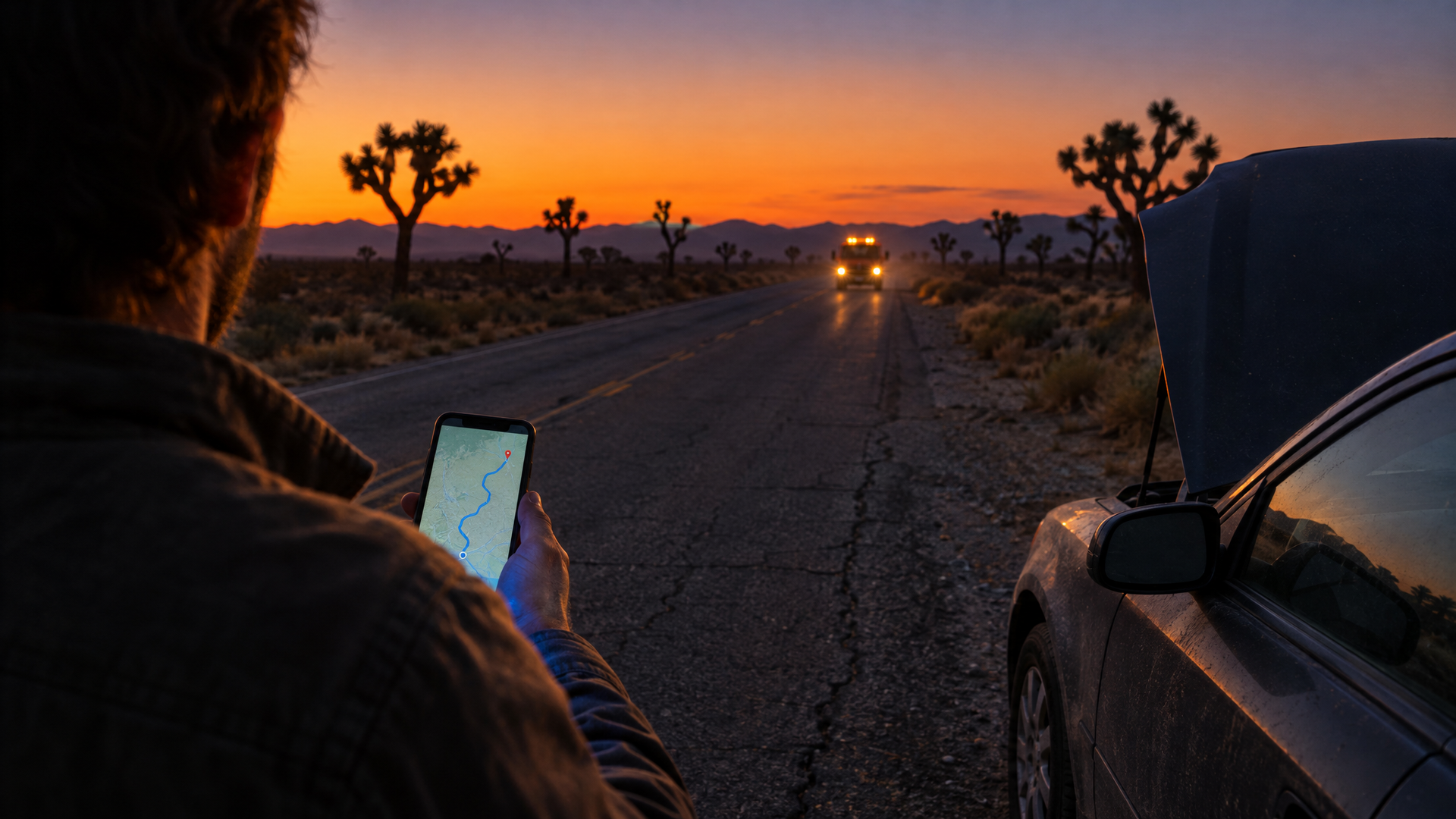
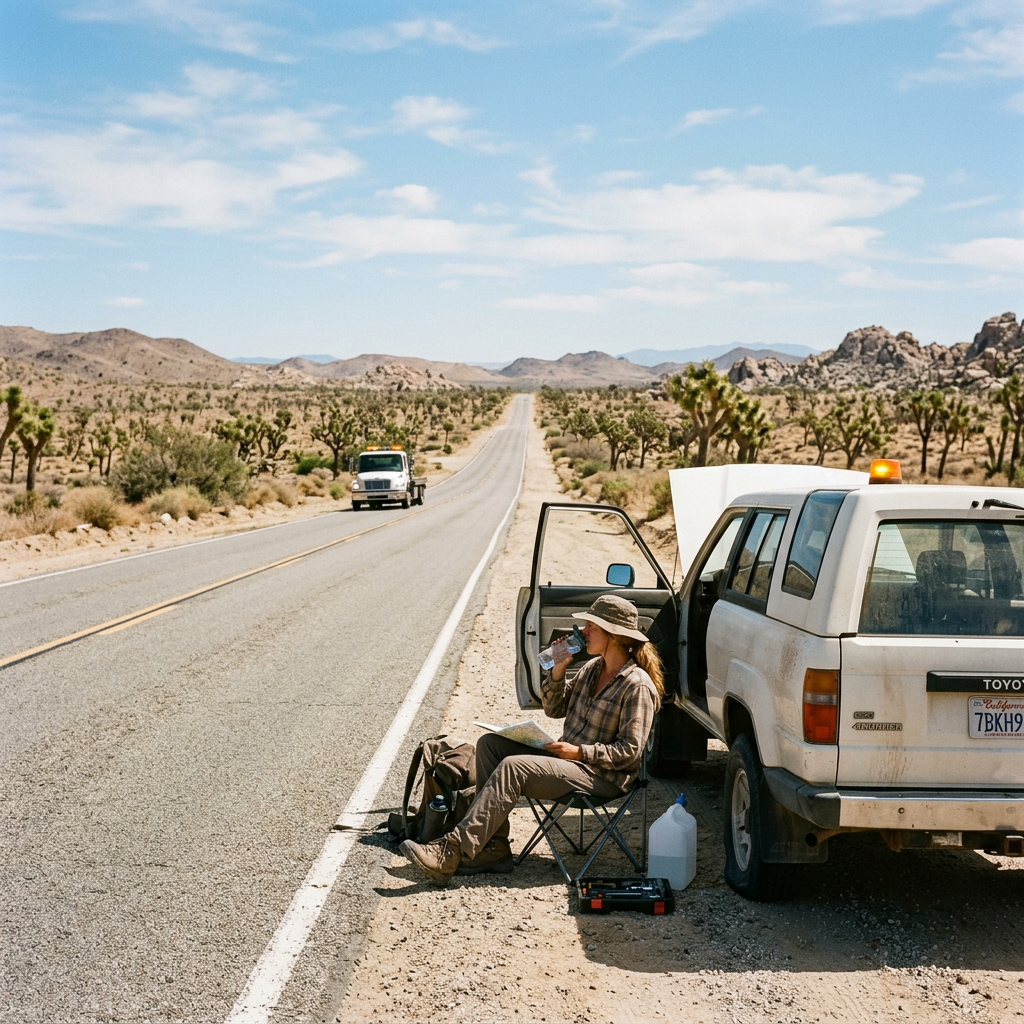
Note your exact location. Cell service across the Twentynine Palms recovery zone is unreliable. Once you have signal, send your GPS coordinates from your phone — don't rely on landmark descriptions alone. "Three miles east of the Cottonwood Visitor Center on the unpaved track" means something very different to someone dispatching from Adobe Road in Twentynine Palms than it does to you sitting in the wash. Open Apple Maps or Google Maps, drop a pin, screenshot it, and include the lat/long when you call. If you're inside Joshua Tree National Park and can't get signal, walk to the nearest paved road or high point and try again — Pinto Basin Road has intermittent signal near the Cholla garden, and the Twentynine Palms entrance near Oasis of Mara is reliable.
Manage heat exposure. This is the Morongo Basin, and the difference between waiting in the shade of your vehicle and standing in direct sun on a July afternoon is the difference between a long wait and a hospital trip. Stay inside the vehicle with windows cracked if possible. Ration water. Conserve phone battery. The same heat rules that apply to a breakdown on Highway 62 between Yucca Valley and Twentynine Palms apply to a stuck call deep in Pinto Basin — only the rescue is going to take longer.
Don't let bystanders try to pull you out. This happens constantly in Joshua Tree National Park. A group of off-roaders comes by, offers to yank you out with a tow strap looped around the bumper, and either rips the bumper off, snaps the strap (which becomes a lethal projectile), or pulls the vehicle out at an angle that damages the frame. If you're in genuine danger — medical emergency, fire risk, traffic exposure — different rules apply. Otherwise, wait for the truck.
How Off-Road Winch-Out Pricing Actually Works in the Twentynine Palms Area
Local off-road recovery in the Morongo Basin doesn't follow standard AAA roadside rates. Pricing depends on four factors: distance from the dispatch base (usually somewhere along Adobe Road or Highway 62 in Twentynine Palms), terrain difficulty, equipment required, and time of day.
A straightforward sand bog within a few miles of pavement on Highway 62 — say, somewhere off the Wonder Valley side roads — typically runs in the range of standard local towing rates plus a recovery fee, because the truck can drive most of the way on graded surface. A deep-terrain recovery in the southern section of Joshua Tree National Park or out past the Sheep Hole Mountains involves substantially more time, fuel, and risk to the truck, so pricing reflects that. Night recoveries, off-camber pulls requiring multiple anchor points, and winter weather adds to the cost. Long-distance flatbed transport from a recovery point back to a shop in Palm Springs, Yucca Valley, or San Bernardino is billed separately from the recovery itself.
The cheapest off-road recovery is the one that never happens — which is why local operators in the Twentynine Palms market spend so much time on prevention advice. The next cheapest is the one where the customer didn't make it worse before help arrived. The most expensive is the one where someone gunned the engine for ten minutes, buried the vehicle to the axles, then let a bystander pull on the bumper before the truck got there.
Why You Want a Locally-Based Twentynine Palms Recovery Operator
National dispatch services don't work for off-road recovery in the Morongo Basin. The reason is simple: the operator on the other end of an 800 number routing through Phoenix or Atlanta doesn't know which sections of Berdoo Canyon are safe for a 30,000-pound wrecker to enter, which spots on Old Dale Road have hidden mud under the sand, or that the unpaved section past the Cottonwood Visitor Center can swallow a low-clearance truck inside ten minutes. A properly equipped, locally-dispatched recovery operation knows the Morongo Basin terrain because they work in it every week — recovering Marine families' vehicles from training-area edges near the MCAGCC base, pulling tourists out of Joshua Tree National Park, and winching locals off the sandy shoulders of Amboy Road heading east toward the Cadiz Valley.
When you call, ask the dispatcher specifically: where are your trucks based, what's your real ETA to my location, and do you have winch capacity and recovery boards on your truck right now. A local Twentynine Palms operator will give you a concrete answer in the first ten seconds of the call.
Save the Number Before You Need It
If you're planning to drive any unpaved road in the Twentynine Palms area — Pinto Basin Road past the pavement break, Old Dale Road, Berdoo Canyon, Amboy Road, the Geology Tour Road inside Joshua Tree National Park, or any of the BLM routes north of the MCAGCC base boundary — save a local Twentynine Palms recovery number in your contacts before you leave the pavement. The middle of a winch-out emergency is not when you want to be searching for "tow truck near me" on a phone with 14% battery and one bar of signal.
Twentynine Palms Towing operates locally-dispatched recovery trucks across the Morongo Basin, including 24/7 emergency towing, off-road winch-outs from sand, mud, and rock terrain, flatbed loading from unpaved access points, and long-distance flatbed transport to shops in Palm Springs, Yucca Valley, San Bernardino, and beyond. See our full service list for everything we cover across the Morongo Basin. We're licensed, insured, and we know the desert because we live and work in it.
Call (442) 205-6198 — 24 hours a day, 7 days a week. Serving Twentynine Palms, Joshua Tree, Yucca Valley, Wonder Valley, Landers, Pioneertown, Morongo Valley, and the full Highway 62 corridor.
The desert doesn't wait. Save the number now.
Frequently Asked Questions
How much does it cost to winch a vehicle out of the sand in Twentynine Palms?
Pricing depends on distance from our Twentynine Palms dispatch base, terrain difficulty, and equipment required. A near-pavement sand bog off Highway 62 is a relatively standard call; a deep-terrain recovery inside Joshua Tree National Park or past the Sheep Hole Mountains involves more time and equipment and is priced accordingly. Call (442) 205-6198 for a free quote based on your specific location.
Can a regular tow truck pull a vehicle out of the desert sand?
No. Standard wreckers built for paved-surface recovery in Yucca Valley, Joshua Tree, or Twentynine Palms commercial areas are not equipped or trained for sand and off-road work. Off-road recovery requires a properly equipped truck, synthetic winch line, snatch blocks, recovery boards, and an operator experienced in desert terrain. Using the wrong equipment damages vehicles.
What should I do if I'm stuck in sand inside Joshua Tree National Park?
Stop driving immediately to prevent digging in deeper. Get out and assess whether you're bogged or high-centered. Note your exact GPS coordinates. Walk toward signal if you have none — Pinto Basin Road near the Cholla Cactus Garden has intermittent service, and the Oasis of Mara entrance near Twentynine Palms is reliable. Call a locally-dispatched Twentynine Palms recovery operator and stay with your vehicle in the shade.
How long does off-road recovery take in the Morongo Basin?
A locally-dispatched recovery from Twentynine Palms typically reaches near-pavement locations in 30 to 45 minutes. Deep-terrain recoveries inside Joshua Tree National Park or in remote areas east of Wonder Valley take longer — generally 60 to 90 minutes depending on access route and conditions. National dispatch services routed through Palm Springs or further can take two to three hours, which is one of the main reasons to use a local operator.
Will my insurance or AAA cover an off-road winch-out?
Most standard AAA memberships and basic insurance roadside coverage explicitly exclude off-road recovery and unimproved-surface towing. Premium AAA tiers and some specialty off-road insurance policies cover portions of recovery costs. Check your specific coverage before you go, and have a backup recovery service number saved regardless.
Do you recover motorcycles from off-road locations near Twentynine Palms?
Yes. We provide flatbed recovery for motorcycles, ATVs, and side-by-sides from unpaved access points across the Morongo Basin, including the BLM areas north of MCAGCC, the unpaved sections of Pinto Basin Road, and the back routes near Wonder Valley. Call (442) 205-6198 with your location and vehicle type.