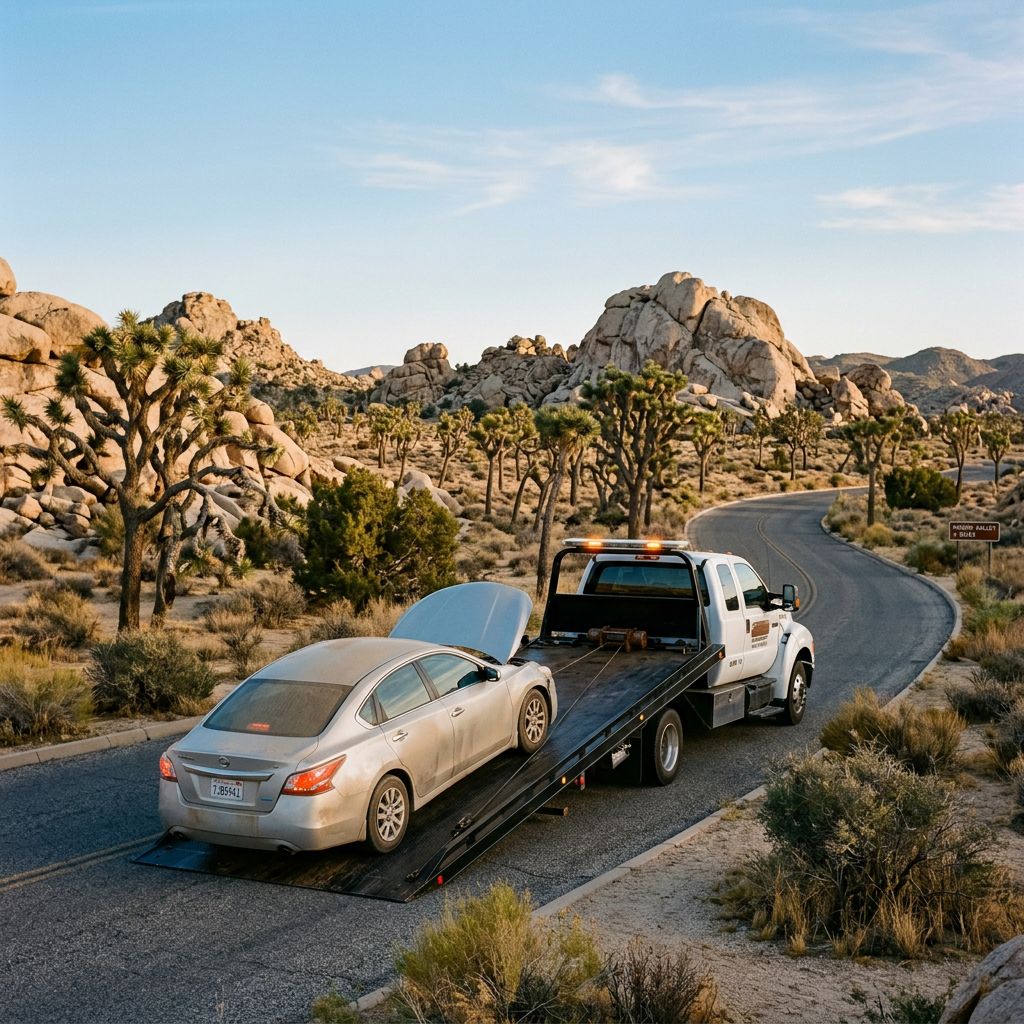
Stranded in Desert Heat Near Joshua Tree? Here's What to Do While You Wait for a Tow
Stranded in Desert Heat Near Joshua Tree? Here's What to Do While You Wait for a Tow
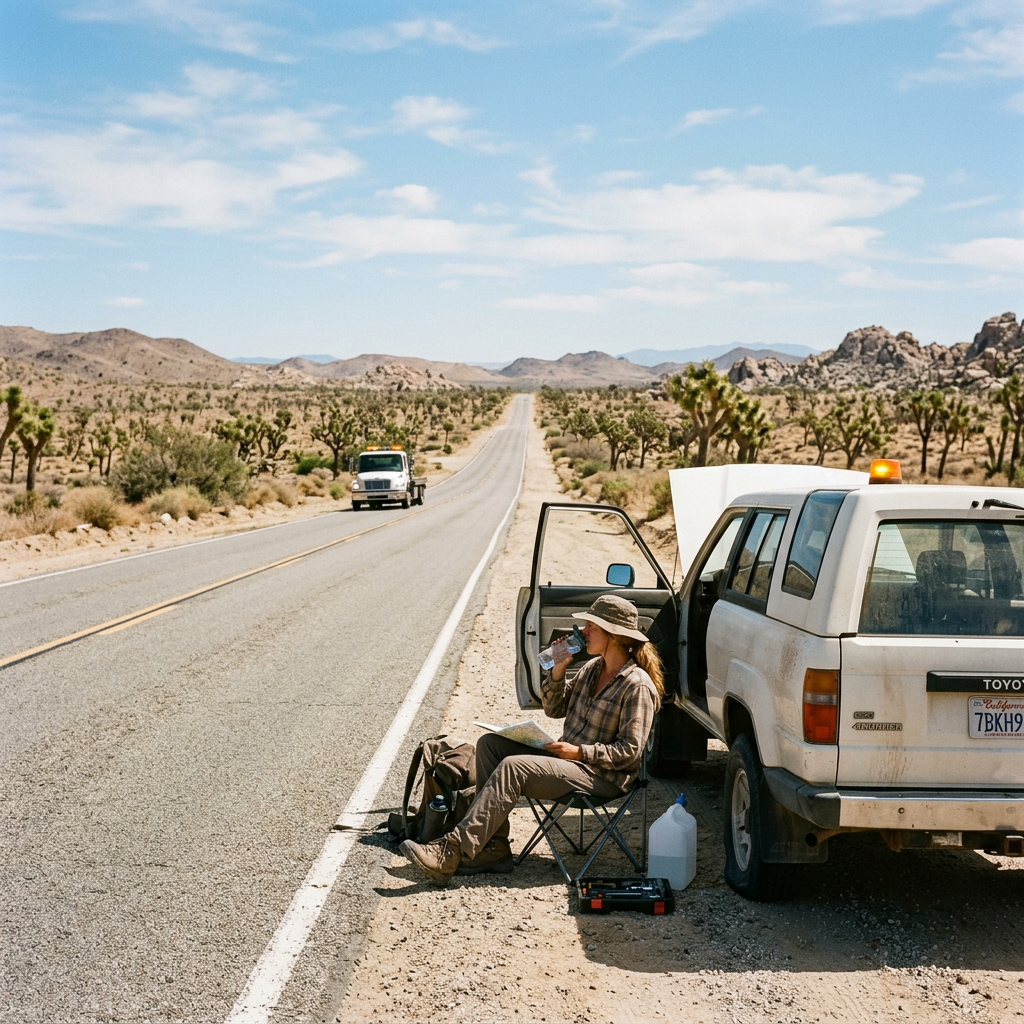
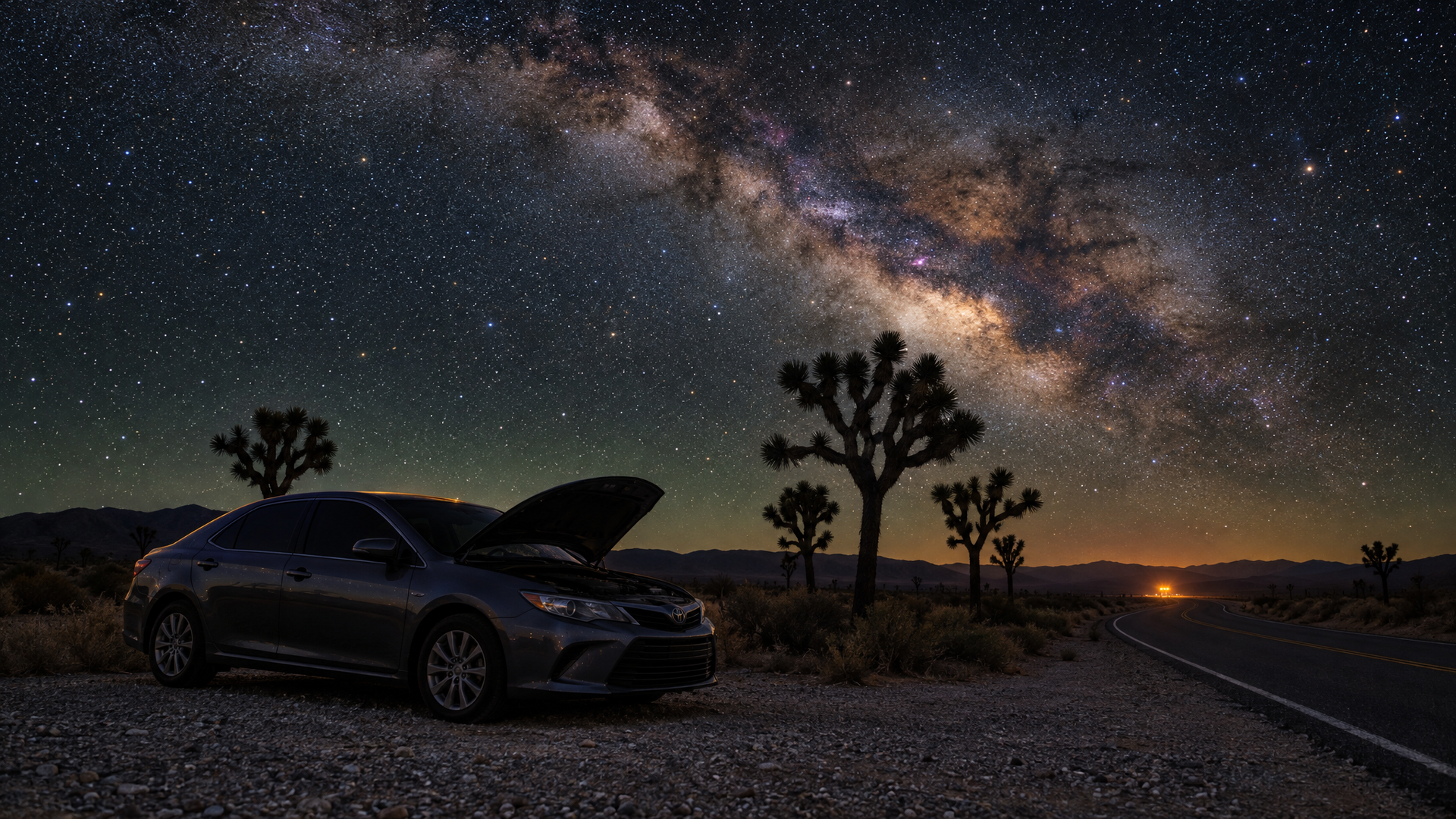
Breaking down anywhere is inconvenient. Breaking down on a remote stretch of Highway 62 in July — with outside temperatures pushing 110°F, no shade in sight, cell service dropping in and out, and the nearest services 20 miles away — is a different situation entirely.
The Morongo Basin is one of the most unforgiving breakdown environments in California. The combination of extreme heat, remote roads, and inconsistent cell coverage means that what you do in the first few minutes after your vehicle stops matters far more here than it would in most parts of the state. A well-handled desert breakdown is a manageable inconvenience. A poorly handled one becomes a medical emergency.
This guide covers exactly what to do from the moment your vehicle stops to the moment our truck arrives. Call (442) 205-6198 the moment you have signal — then use this as your playbook while you wait.
Should you stay in the vehicle or get out?
Stay in the vehicle. This is the single most important decision you'll make in a desert breakdown, and the answer is almost always to stay inside.
A stopped vehicle with the engine off is still significantly cooler than standing in direct desert sun. The National Highway Traffic Safety Administration has documented that vehicle interior temperatures can rise rapidly — but a closed car in shade or with windows cracked still provides meaningful insulation from the direct sun that accelerates heat illness when you're standing outside. In extreme desert conditions, shade from the vehicle's body is far better than nothing at all.
The exceptions: if your vehicle is on fire, if you smell fuel, or if you're on a section of Highway 62 with no shoulder and traffic is passing at highway speeds at dangerous proximity. In those cases, get out — but move perpendicular to the road, away from traffic, not along the shoulder.
For the vast majority of desert breakdowns, your vehicle is the safest place you can be. Stay in it, windows cracked for airflow, until help arrives.
What should you do first when your vehicle stops?
The sequence matters. Here's the order:
1. Move off the road completely. If the vehicle is still moving under any power, get it as far off the pavement as possible before stopping. On Highway 62 between Morongo Valley and Yucca Valley, and on the stretches between Joshua Tree and Twentynine Palms, the shoulders are narrow and traffic moves fast. Even a few extra feet off the road changes your safety margin significantly. On Pinto Basin Road, Adobe Road, or any unpaved park access route, the sand shoulder is your friend — use it.
2. Turn on your hazard lights immediately. Even in daylight, flashing hazards are visible at distance on straight desert roads. Keep them on. Your battery can handle hazards for several hours even without the engine running.
3. Deploy whatever visual signals you have. Road flares, reflective triangles, or anything bright-colored placed 50–100 feet behind your vehicle gives approaching drivers additional warning time — especially critical on Highway 62 where speeds regularly exceed 65 mph.
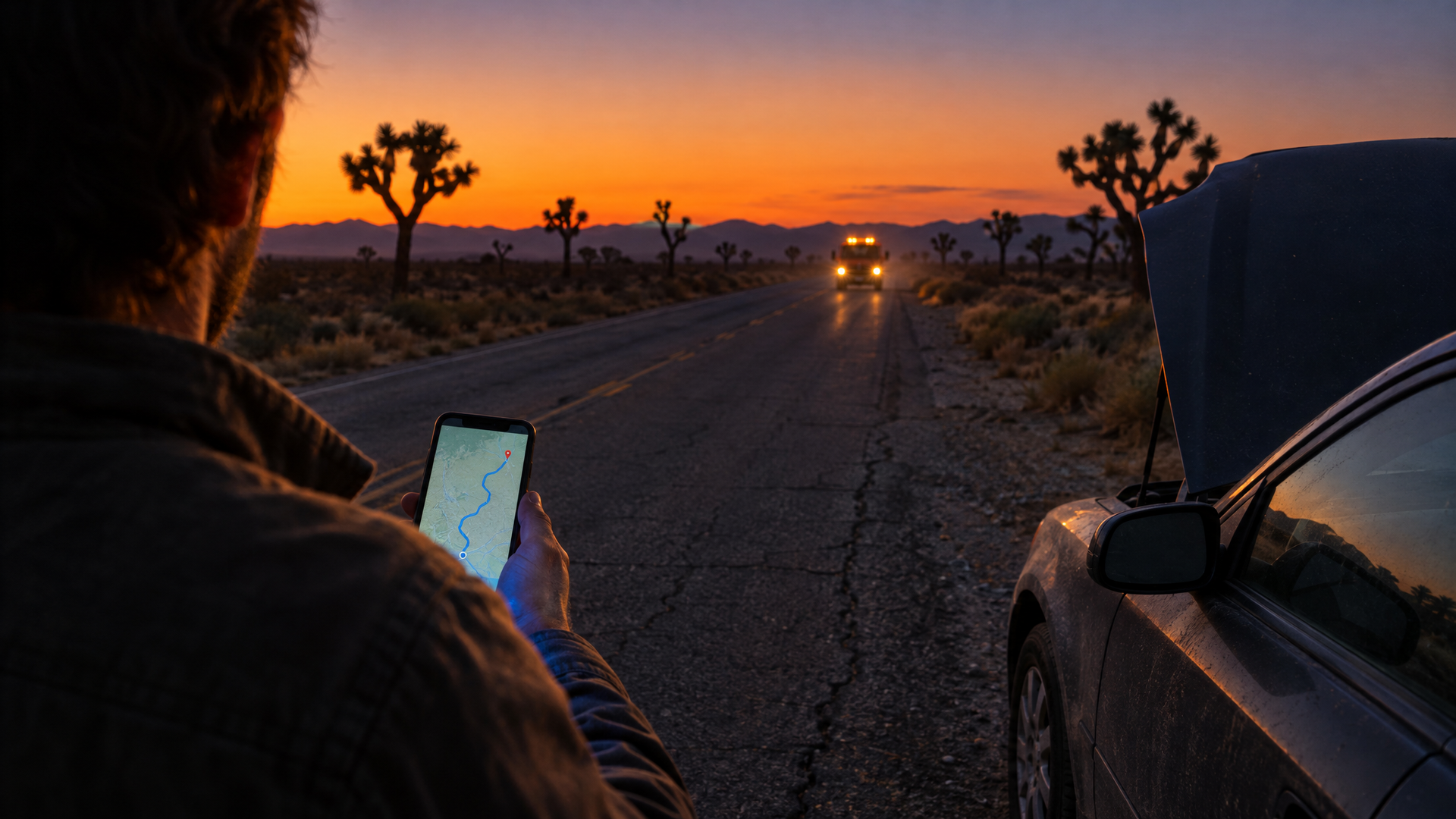
4. Call for help while you still have signal. Cell coverage in the Morongo Basin is inconsistent. The area between Morongo Valley and Yucca Valley has known dead zones, and much of Joshua Tree National Park — including Pinto Basin Road, Wonder Valley, and the routes toward Cottonwood Springs — has no reliable service. If you have any signal at all, use it immediately to call Twentynine Palms Towing at (442) 205-6198 before you lose it. For Joshua Tree National Park breakdowns, our full guide to park breakdown procedures covers your options when signal drops out entirely.
How do you manage heat while waiting in a desert breakdown?
This is where the desert changes the calculus compared to a breakdown anywhere else in California. Heat illness — ranging from heat exhaustion to heatstroke — can develop faster than most people expect at extreme temperatures.
Ration water, don't conserve it entirely. If you have water, drink it. Heat-related illness accelerates dehydration, and trying to "save" water by not drinking is counterproductive. Drink small amounts consistently rather than large amounts at once.
Keep windows cracked, not wide open. A small gap allows airflow without letting the full solar heat in. If you're parked in the sun, even partial shade from the vehicle's own shadow is better than opening windows fully.
Use shade from the vehicle strategically. If you need to exit the vehicle — to deploy flares, check a tire, or get signal — stay in the vehicle's shadow. The roof line, door panels, and wheel wells all cast usable shade. Desert sun can cause burns on exposed skin in under 30 minutes at peak summer temperatures in the 29 Palms and Joshua Tree area.
Conserve your phone battery. Reduce screen brightness to minimum, disable apps running in the background, and turn off Bluetooth and WiFi radios to extend your battery life. That phone is your primary emergency tool. If you're in a dead zone, drive or walk only to the closest high point or known signal area — don't wander looking for coverage.
Know the signs of heat illness. According to the California Governor's Office of Emergency Services, early symptoms of heat-related illness include heavy sweating, weakness, cold or pale skin, a weak pulse, nausea, or fainting. Heatstroke — the severe end of the spectrum — is marked by a high body temperature above 103°F, hot and dry skin with no sweating, rapid strong pulse, and possible unconsciousness. If any of those symptoms appear in anyone in your vehicle, call 911 immediately, as this is a medical emergency. Our tow truck and emergency services are separate responses — don't delay a 911 call waiting for us.
What if you're inside Joshua Tree National Park when you break down?
The park's interior presents specific challenges that don't apply to Highway 62 or the Twentynine Palms city area. Cell service is unreliable across most of the park's 790,000 acres — there are known signal areas near the Oasis of Mara visitor center and the Joshua Tree Visitor Center near the west entrance, but much of the interior between Hidden Valley, Skull Rock, and Cottonwood Springs has no reliable coverage.
If you break down in the park's interior:
Move to the best available shade your vehicle or nearby rock formations can provide. Cholla Cactus Garden, Hidden Valley, and the areas near Skull Rock have some natural shade from rock formations. Pinto Basin Road and the routes toward Cottonwood Springs have very limited natural shade.
Attempt to reach signal by driving slowly — under 15 mph if possible to avoid further mechanical stress — toward the nearest visitor center or park entrance before fully stopping. The main west entrance on Park Boulevard near Joshua Tree town is approximately 25 miles from the Cottonwood Visitor Center entrance on the park's south end.
Flag down other park visitors. Joshua Tree National Park receives millions of visitors annually, and the main interior routes see consistent traffic, particularly on weekends from October through May. Another visitor can drive to signal and call for help or contact a park ranger.
If you reach a park ranger, they can radio for assistance even without cell coverage. Our complete guide to Joshua Tree National Park breakdowns covers what park rangers can and can't do, and how our flatbed towing service handles recoveries from park roads and unpaved terrain.
What if you break down at night on Highway 62 or a remote desert road?
Night breakdowns on Highway 62 and remote Morongo Basin roads carry different risks than daytime ones. The heat concern drops significantly after sunset, but visibility becomes the primary hazard. Desert roads at night — particularly the sections of Highway 62 between Morongo Valley and Yucca Valley and the connector roads between the park and Wonder Valley — have minimal lighting and drivers who may not expect a stopped vehicle.
Keep hazards running throughout the night. Your vehicle battery has enough reserve for this. The visual signal is critical.
Stay inside and visible. Interior dome lights on low make you visible to approaching vehicles without blinding them. Keep reflective triangles or flares deployed behind the vehicle at appropriate distance — 100 feet minimum on highway speeds, 50 feet minimum on lower-speed desert roads.
Don't walk along the shoulder at night. Pedestrians on desert highways at night are extremely difficult for drivers to see. If you need to move, move perpendicular to the road and away from traffic — never parallel to it in the lane area.
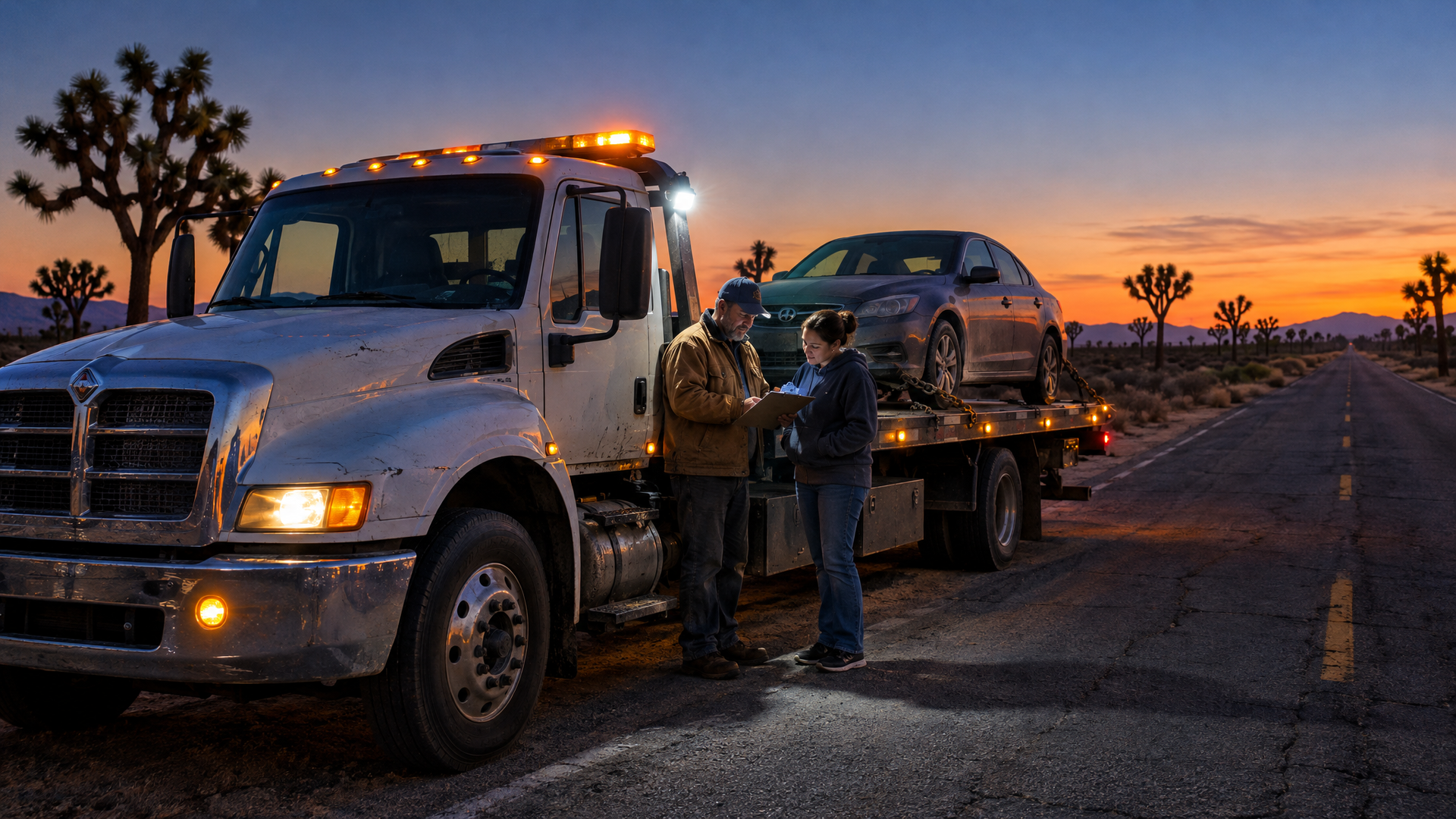
For 24/7 night response anywhere on Highway 62, in Yucca Valley, Twentynine Palms, Wonder Valley, Landers, or Morongo Valley, our emergency towing service operates around the clock. Our roadside assistance covers jump starts, lockouts, flat tire changes, and fuel delivery — which often solves the situation without a tow at all.
Before You Drive Into the Desert: The 60-Second Preparation
The best time to handle a desert breakdown is before it happens.
Save (442) 205-6198 in your phone contacts right now, before you put the phone down. Label it "29 Palms Towing" or "Desert Breakdown." When you're on Pinto Basin Road with two bars of signal fading fast, you don't want to be searching Google. You want to tap one contact.
Beyond that: carry a minimum of two gallons of water per person for any extended desert drive. Keep a basic roadside kit — jumper cables or jump pack, reflective triangles, a flashlight, and a basic first aid kit — in the vehicle year-round. Check your tire pressure and coolant level before heading out on any remote Morongo Basin route.
The Marine Corps Air Ground Combat Center in Twentynine Palms coordinates some of the most logistically complex vehicle operations in the world across 930 square miles of desert terrain. The lesson from that context applies directly here: preparation before you move saves the situation when things go wrong in the field.
Frequently Asked Questions
How long does it take for Twentynine Palms Towing to reach a breakdown on Highway 62?
For breakdowns within Twentynine Palms city limits and the immediately surrounding area, our typical response time is under 30 minutes. For outlying areas including Yucca Valley, Wonder Valley, Landers, and Pioneertown, response time varies by location and road conditions. Call
(442) 205-6198 for a specific ETA to your location — our dispatchers know the Highway 62 corridor and will give you a real number, not a national dispatch estimate.
Can you tow a vehicle from inside Joshua Tree National Park?
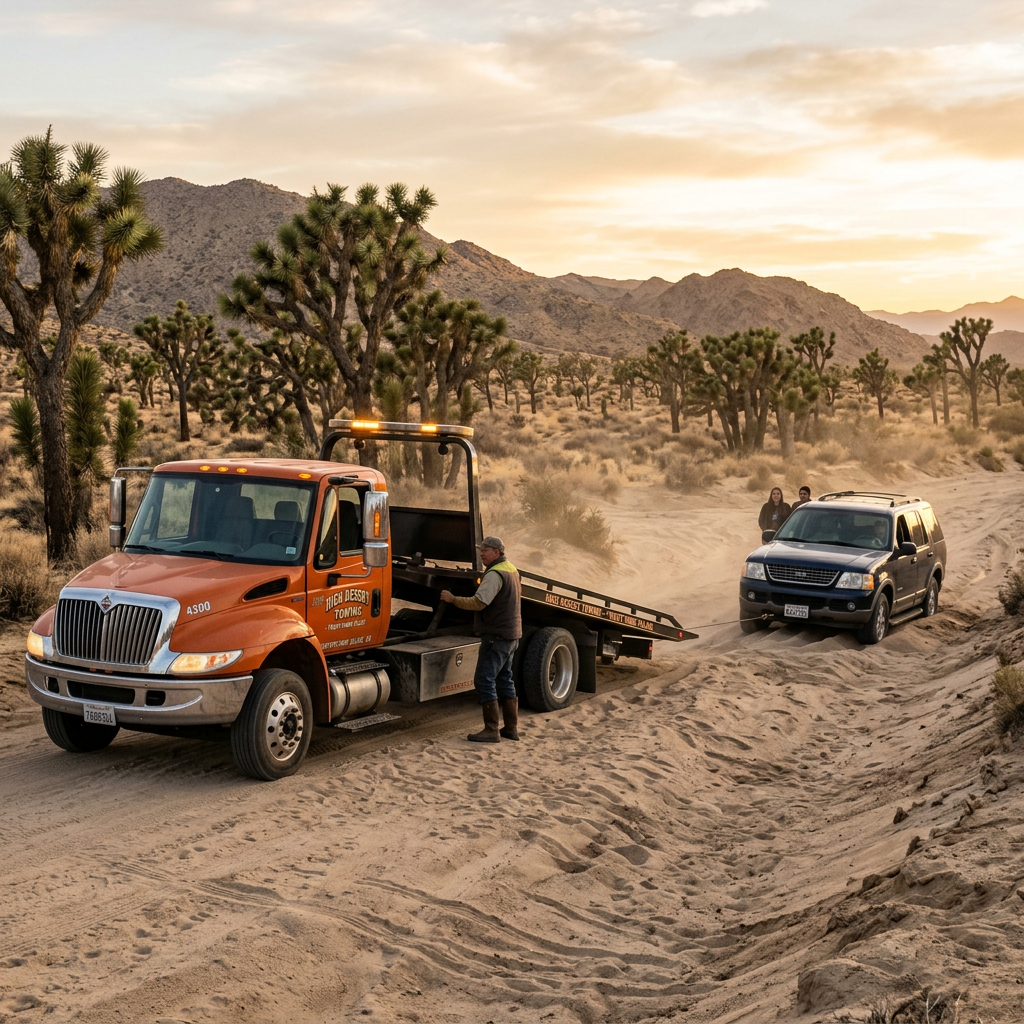
Yes. We regularly recover vehicles from inside Joshua Tree National Park, including from unpaved access roads, sandy desert terrain, and the Pinto Basin Road corridor. Our
flatbed trucks are equipped for off-road desert recovery. See our
full Joshua Tree National Park breakdown guide for what to expect.
What roadside assistance services do you provide in the High Desert?
We cover jump starts, lockout service, flat tire changes, fuel delivery, and winch-out recovery for vehicles stuck in sand or off-road terrain across the Morongo Basin. Full details at our
Twentynine Palms roadside assistance page. Available 24/7.
Is it dangerous to stay in a vehicle broken down in the desert heat?
Staying in the vehicle is generally the safer option compared to standing in direct desert sun. Keep windows cracked for airflow, stay in the vehicle's shade if you need to exit, and ration water while monitoring for signs of heat illness. If anyone shows symptoms of heatstroke — confusion, hot dry skin, rapid strong pulse — call 911 immediately.
Do you serve Yucca Valley, Joshua Tree, and Wonder Valley in addition to Twentynine Palms?
Yes. We serve the full Morongo Basin including Twentynine Palms, Yucca Valley, Joshua Tree, Wonder Valley, Landers, Pioneertown, Morongo Valley, and the Highway 62 corridor from the Coachella Valley to Rice Road. See our
Yucca Valley and Morongo Basin corridor coverage guide for more on specific service areas.
Twentynine Palms Towing serves the full Morongo Basin 24 hours a day, 7 days a week, 365 days a year. Locally dispatched from 73421 29 Palms Hwy, Twentynine Palms, CA 92277. Call (442) 205-6198.