Tesla and EV Towing in Joshua Tree, Twentynine Palms, and the High Desert: What Most Tow Companies Get Wrong
Tesla and EV Towing in Joshua Tree, Twentynine Palms, and the High Desert: What Most Tow Companies Get Wrong
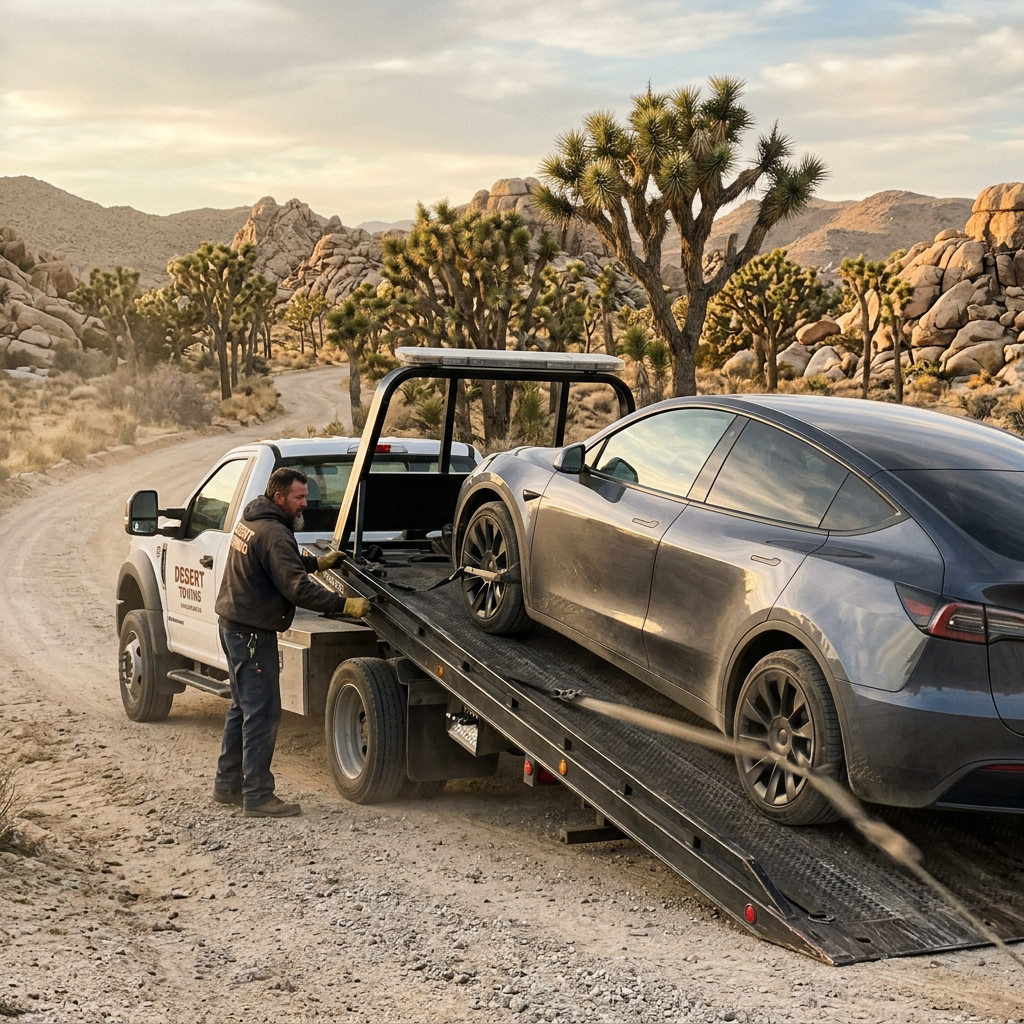
If you drive a Tesla, Rivian, Ford F-150 Lightning, Mustang Mach-E, Hyundai Ioniq, Kia EV6, Lucid, or any other electric vehicle into the Morongo Basin, the towing service you save in your phone matters more than you think. Most national tow dispatch services that show up to Highway 62 breakdowns don't have a flatbed available on short notice — and a standard wheel-lift tow truck will destroy your EV's drivetrain.
This isn't an opinion. Tesla's own Model 3 owner's manual explicitly states: "Do not transport the vehicle with wheels on the ground." The same principle applies to virtually every other production EV on the road. If your car is electric, it goes on a flatbed — full stop. Here's what most tow companies get wrong, and what you actually need to know before you break down between Yucca Valley and the Park Boulevard entrance to Joshua Tree National Park. Tesla
We're the local 24/7 flatbed-equipped towing company serving Twentynine Palms, Joshua Tree, Yucca Valley, and the full Morongo Basin. Call (442) 205-6198 any time, day or night.
Why Can't a Tesla Be Towed With Its Wheels on the Ground?
A Tesla's electric motors are directly connected to the wheels through a single-speed gearbox — there's no neutral gear that disconnects the motor from the drivetrain like there is in a gas car. When the wheels spin without the motor being powered and managed by the car's electronics, those motors act as generators, producing uncontrolled electrical current that has nowhere to go. The result is heat, internal resistance, and potential permanent damage to the motor windings and inverter.
When the wheels spin during improper towing, those motors generate electricity without proper system control. That uncontrolled current creates heat and internal resistance that can permanently destroy the motor. Tesla explicitly prohibits flat towing for any real distance. This damage is not covered under Tesla's warranty when it's caused by improper transport. Geyer Stowing
What this means in practice for Joshua Tree visitors:
- Wheel-lift tow trucks (the common kind with two arms that lift two wheels) are not safe for any Tesla
- Hook-and-chain trucks (older style) are absolutely not safe for any Tesla
- Flat-towing behind an RV or another vehicle with all four wheels rolling is not safe for any Tesla
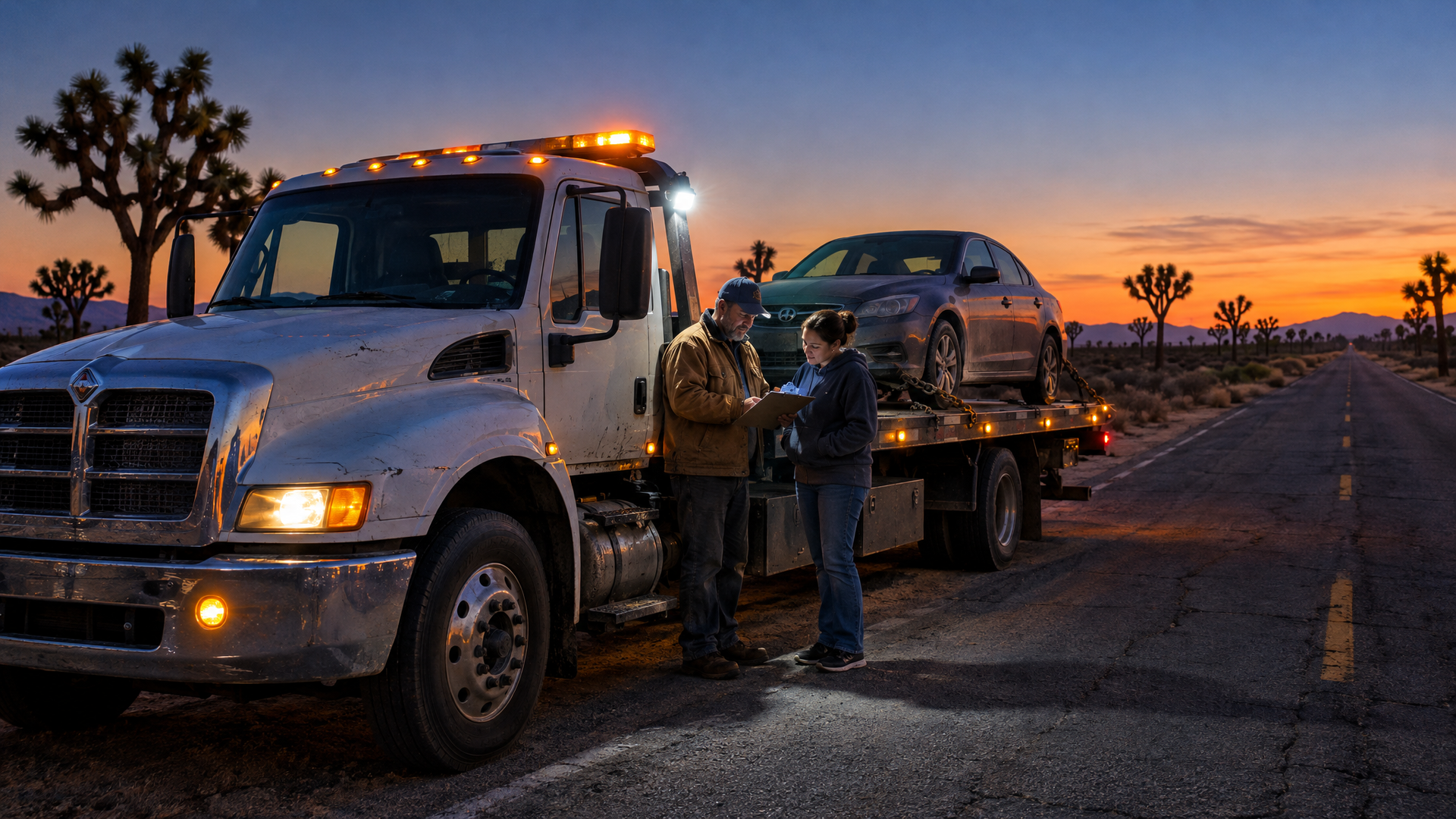
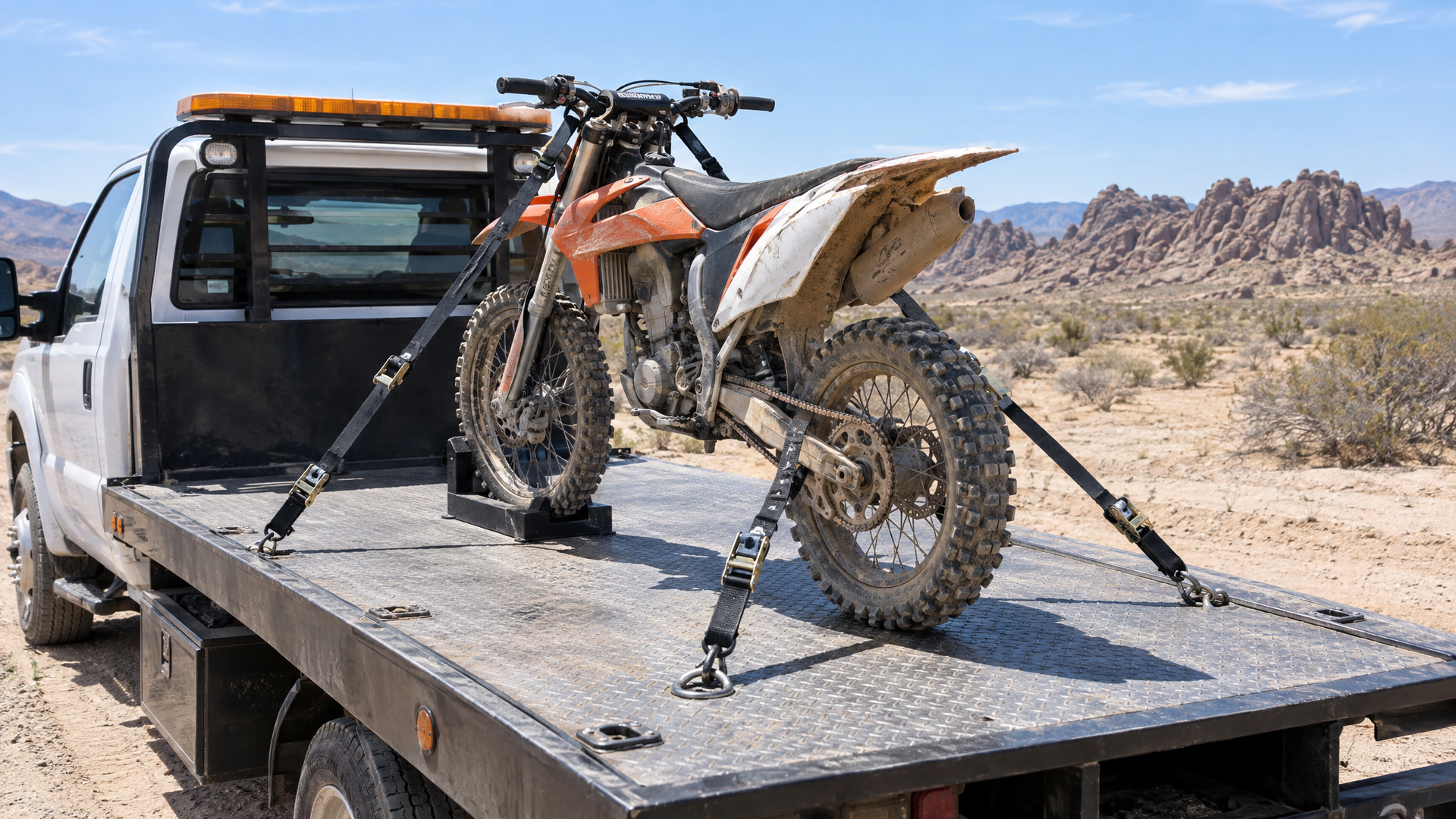
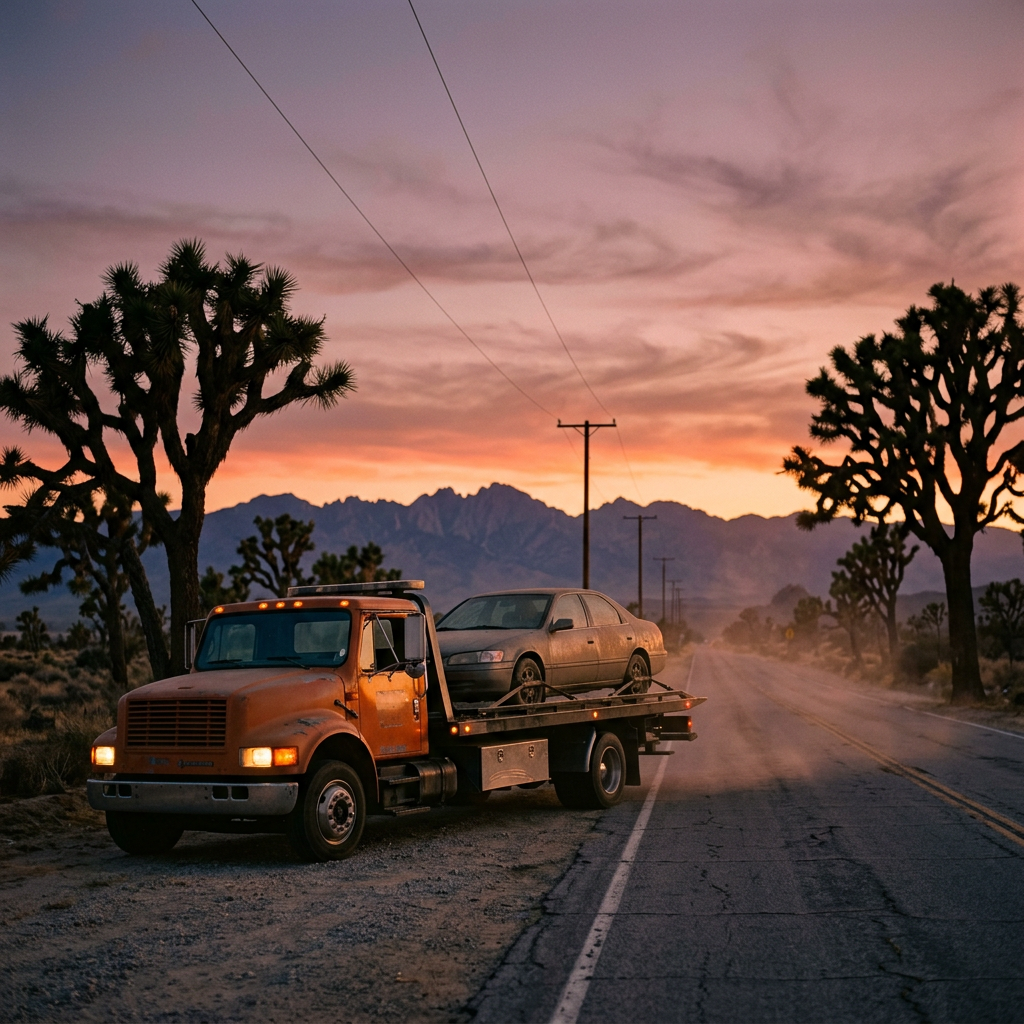
- Flatbed transport with all four wheels off the ground is the only acceptable method
If a tow operator arrives in a wheel-lift truck and tells you "it'll be fine for a short distance," they're either uninformed or they're hoping the damage doesn't show up until after they've left.
What Other EVs Require Flatbed-Only Towing?
The Tesla rules aren't Tesla-specific — they apply to virtually every modern battery-electric vehicle. The same direct-drive motor architecture that makes EVs so responsive also makes wheel-on-the-ground towing unsafe for the drivetrain.
EVs that require flatbed-only towing:
- Tesla — Model 3, Model Y, Model S, Model X, Cybertruck (all of them)
- Rivian — R1T, R1S
- Ford — Mustang Mach-E, F-150 Lightning, E-Transit
- Hyundai — Ioniq 5, Ioniq 6, Kona Electric
- Kia — EV6, EV9, Niro EV
- Chevrolet — Bolt EV, Bolt EUV, Equinox EV, Blazer EV, Silverado EV
- Lucid — Air, Gravity
- Mercedes-Benz — EQS, EQE, EQB, EQS SUV
- BMW — i4, i5, i7, iX, iX3
- Audi — e-tron GT, Q4 e-tron, Q6 e-tron, Q8 e-tron
- Polestar — Polestar 2, Polestar 3, Polestar 4
- Volkswagen — ID.4, ID. Buzz
- Nissan — Ariya, Leaf
- Volvo — EX30, EX90, C40 Recharge, XC40 Recharge
The general rule: if it's pure battery-electric (BEV), it goes on a flatbed. The few exceptions among hybrids and plug-in hybrids vary by manufacturer — when in doubt, the safe default is flatbed. Our flatbed and auto wrecking service is the right call for any EV regardless of brand.
How Do You Activate Tesla Transport Mode on a Model 3, Y, S, or X?
Tesla Transport Mode (sometimes called Tow Mode) is what allows the car to be winched onto a flatbed without the parking brake engaging and skidding the rear tires. Transport Mode prepares your Tesla for safe loading onto a flatbed by disengaging the parking brake and preventing the vehicle from automatically shifting into Park when the driver exits. Geyer Stowing
The procedure (Model 3 and Model Y, current software):
- Tap the brake pedal to wake the car
- Shift the car into Park
- On the touchscreen, tap Controls → Service → Towing
- Press and hold Transport Mode until the message confirms it's active
- The display will show a yellow warning that Transport Mode is engaged
Tesla's Transport Mode limits acceleration on the vehicle to 3 miles per hour for 30 feet (or 10 meters). If rolled faster or for longer than these recommendations, you risk overheating the car. Transport Mode is only for winching onto the flatbed — not for any kind of actual rolling transport. Rechargd
The critical wrinkle: if your Tesla's 12V battery is dead, you can't activate Transport Mode through the touchscreen. This happens more often than people realize, especially in desert heat or when a car has been parked at a vacation rental for several days. A competent EV tow operator carries a 12V jump pack to wake the electronics long enough to activate Transport Mode and load the car safely.
Tow eye location for Model 3 and Y: under the carpet in the front trunk (frunk), upper-left quadrant. The threaded tow hook screws into the front or rear bumper depending on which direction the car needs to be pulled. If you've never used yours, that's worth knowing before you need it.
Why Do EVs Break Down More Often in the High Desert?
Battery-electric vehicles face specific failure modes in the Morongo Basin that don't show up the same way in coastal or valley climates. Extreme heat is the dominant variable — and Twentynine Palms regularly exceeds 110°F from June through September.
What goes wrong with EVs in desert heat:
- Thermal throttling — battery management systems reduce performance and charging rates to protect the pack when temperatures climb
- Accelerated range degradation — real-world range can drop 15–25% in extreme heat as the battery thermal management system runs the AC compressor and battery coolant pumps continuously
- 12V auxiliary battery failure — the small lead-acid (or lithium) 12V battery that runs the car's electronics fails faster in heat, leaving the high-voltage pack disconnected and the car unresponsive
- Cabin overheat protection — parked Teslas run the AC to keep cabin temps below 105°F, which drains the battery and accelerates 12V failure if you're parked for hours at a Joshua Tree trailhead
- Supercharging slowdown — Tesla throttles charge rates above certain pack temperatures, meaning your "20-minute charge" at the 29 Palms Supercharger can stretch to 45+ minutes on a hot afternoon
- Tire failures — heat-stressed rubber on long highway stretches blows out more often, especially on the climb from I-10 up through Morongo Canyon
- Range anxiety leading to roadside dead-battery calls — drivers underestimating how much extra power desert heat consumes and running out of charge between Superchargers
We pick up Teslas and EVs out of Joshua Tree National Park, off Pinto Basin Road, on Park Boulevard, at vacation rental driveways across Yucca Valley and Joshua Tree town, and on the Highway 62 shoulder between Morongo Valley and the 29 Palms city limits. The patterns are consistent.
Where Are the Closest Tesla Superchargers to Joshua Tree National Park?
The closest Supercharger to Joshua Tree National Park is the Twentynine Palms Supercharger at the Tortoise Rock Casino — 73829 Baseline Road, Twentynine Palms. It has 8 stalls, available 24/7, up to 150kW max charging. This Supercharger is essentially at the north entrance to Joshua Tree National Park (Utah Trail entrance) and is the obvious charging stop for anyone visiting the park's interior or staying in 29 Palms. Chargemap
Other relevant Superchargers within range:
- Palm Springs — multiple Supercharger locations in the Palm Springs / Cathedral City area, all under an hour from Yucca Valley via Highway 62
- Indio — large Supercharger station off I-10, common stop for Coachella weekend traffic
- Needles — far east on I-40, relevant only for cross-desert routing toward Arizona
What there is not anywhere in the area:
- No Superchargers inside Joshua Tree National Park at all
- No Superchargers in Yucca Valley town itself (the 29 Palms station is the closest)
- No Superchargers in Joshua Tree town itself
- No high-speed CCS or NACS chargers anywhere along Highway 247 toward Landers or Johnson Valley
If you're driving an EV deep into the park or out toward Pioneertown or Landers, plan your charge stops carefully. The Tortoise Rock Casino Supercharger is the closest reliable fast-charge point for the entire Morongo Basin region.
What Should You Do If Your EV Won't Start at a Joshua Tree Vacation Rental or in the National Park?
The most common EV emergency call we get in the Morongo Basin isn't a crash or a flat tire — it's an EV that won't respond at a vacation rental after sitting for two or three days in desert heat. The owner approaches the car, the phone-key won't unlock the doors, the touchscreen is black, and the car is functionally unresponsive. Almost every time, this is a dead 12V auxiliary battery.
What to do if your EV won't wake up:
- Check for a manual key access point. Most EVs have a physical key card or hidden manual unlock. For Teslas, the phone key may still work via the door pillar NFC sensor; if not, a physical key card unlocks the driver's door
- Try jump-starting the 12V battery. Most EVs have an external 12V jump terminal in the frunk or behind a cover near the front bumper. A portable jump pack on the 12V terminals will wake the electronics enough to activate Transport Mode
- Call a flatbed-equipped tow operator if jump-starting doesn't work. Don't let a wheel-lift tow truck near your EV regardless of what the dispatcher tells you
- For breakdowns inside Joshua Tree National Park — see our Joshua Tree National Park breakdown guide for cell-service zones and what to do when you can't get a call out
If you've already burned phone battery trying to call the rental company or your insurance roadside service and gotten nowhere, save our number now: (442) 205-6198. We dispatch from the Morongo Basin, we carry flatbeds, and our drivers know EV transport procedure.
Why Do Most National Dispatch Tow Companies Fail EV Calls?
National dispatch services — the ones your rental company calls, the ones your insurance roadside benefit routes to, the ones Tesla's own roadside assistance sometimes contracts with — operate on a low-bid contractor model. They don't own trucks. They route your job to whichever local operator agrees to the lowest fee, and that operator is whoever happens to be available, not whoever has the right equipment for an EV.
The failure modes are predictable:
- Wheel-lift trucks dispatched to EV calls because they're cheaper to operate and more common — but they cannot safely tow an EV
- "Flatbed" promised but not delivered — dispatcher says flatbed, contractor sends wheel-lift, customer doesn't know the difference until damage shows up
- No knowledge of Transport Mode — driver shows up, can't load the car, gives up or loads it incorrectly
- No 12V jump pack — driver can't wake the car to activate Transport Mode, defaults to dragging or dollying improperly
- Excessive ETAs — by the time a national dispatch finds a flatbed-equipped contractor, you've been waiting 90+ minutes in 110°F heat
A local Morongo Basin tow operator that runs flatbeds and trains drivers on EV transport is a fundamentally different service than what a national broker delivers. For a deeper breakdown of how to evaluate local vs. national towing options, see our guide on choosing a towing company before you're stranded.
What Does Tesla and EV Towing Cost in the Morongo Basin?
EV flatbed towing rates depend on three factors: distance, time of day, and how complicated the load is. Most local Tesla and EV tows inside the Twentynine Palms, Joshua Tree, and Yucca Valley service area fall within standard flatbed pricing, with surcharges for after-hours emergency dispatch, holidays, and recoveries that require 12V jump-start work or unusual access conditions.
What you should expect:
- Upfront quote on the phone before we dispatch the truck — no surprise fees on arrival
- Flatbed equipment confirmed at the time of dispatch, not promised then swapped at the scene
- Driver familiar with EV transport — Transport Mode procedure, 12V jump-start protocol, tow eye location across major models
- Cash, all major credit cards, and most insurance roadside plans (AAA, USAA, GEICO, State Farm, Progressive, Allstate) accepted
- Long-distance flatbed transport available to Palm Springs, San Bernardino, Riverside, or the nearest service center for your vehicle brand
If you need a Tesla or EV moved from a Joshua Tree vacation rental, Park Boulevard inside the National Park, the 29 Palms Supercharger after a failed charging session, or anywhere along the Highway 62 and Highway 247 corridors, we handle it.
Save Our Number Before You Need It
The worst time to research EV-capable towing is when your Model Y won't wake up at a Pioneertown Airbnb on a Sunday morning. By then, your options are limited to whoever the rental company's national dispatch service routes you to — and that's usually a 90-minute wait for a truck that may not even be a flatbed.
Call (442) 205-6198 — we answer 24/7.
Twentynine Palms Towing 73421 29 Palms Hwy, Twentynine Palms, CA 92277 Phone: (442) 205-6198 Hours: Open 24/7, 365 days a year Service area: Twentynine Palms · Joshua Tree · Yucca Valley · Wonder Valley · Morongo Valley · Landers · Pioneertown · MCAGCC · Highway 62 corridor · Highway 247 corridor
Local flatbed service. Real EV transport experience. No national dispatch middleman.